


How to create a sensory space at home.
A sensory space doesn’t have to be insta-worthy!
A sensory space can be a powerful support tool for an autistic child because it gives them a predictable, calming place to regulate their emotions and nervous system. Many autistic children experience the world with heightened or reduced sensitivity, which can make everyday environments feel overwhelming, unpredictable, or exhausting. A dedicated sensory area provides a safe retreat where they can reset — lowering stress, improving focus, and helping them feel more in control of their body and surroundings. It can also encourage exploration, play, and self-soothing in a way that aligns with their sensory preferences rather than working against them.
Importantly, a sensory space doesn’t need to be big, expensive, or Instagram-perfect to be effective. For many families, a small corner of a bedroom, a sectioned-off area of the living room, or even a simple pop-up tent can offer the same benefits as a fully kitted-out sensory room. What matters most is creating a consistent, cosy, low-pressure environment filled with a few carefully chosen items that meet the child’s unique sensory needs — whether that’s soft lighting, comforting textures, movement opportunities, or quiet time. With a bit of creativity, you can build a meaningful sensory haven on any budget and in any home.
Equipment
Sensory swing
Mini trampoline
Sensory tunnel
Body sock
Weighted blanket
Weighted plushie
Weighted vest
Rocker board
Wobble board
Balance board
Balance beam
Fidgets
Vibration plate
Headphones or ear defenders
Climbing wall
Stepping stones
Play tent (black one to block out light)
Balance cushion
Balls
Exercise ball
Textured balls
Hopper ball
Peanut ball
Light up balls
Squishy balls
Stress balls
Ball pit with balls
Tables
Sensory tables
Light table
Light panel
Flooring
Foam tiles
Gym pats
Soft rug
Gel floor tiles
Sensory crash pad
Seating
Bean bag chairs
Wobble stool
Inflatable chair
Lighting
Christmas lights
Fairy lights
LED light strips
Sensory light projector
Waterfall light
Bubble tube
Lava lamp
Fibre optic lamp
Décor
Large pillows
Mirrors
Glow in the dark stickers
Sensory boards or sensory walls
Chalkboards or whiteboards
Magnet board

Asking for reasonable adjustments.
What reasonable adjustments can you request? Free template included

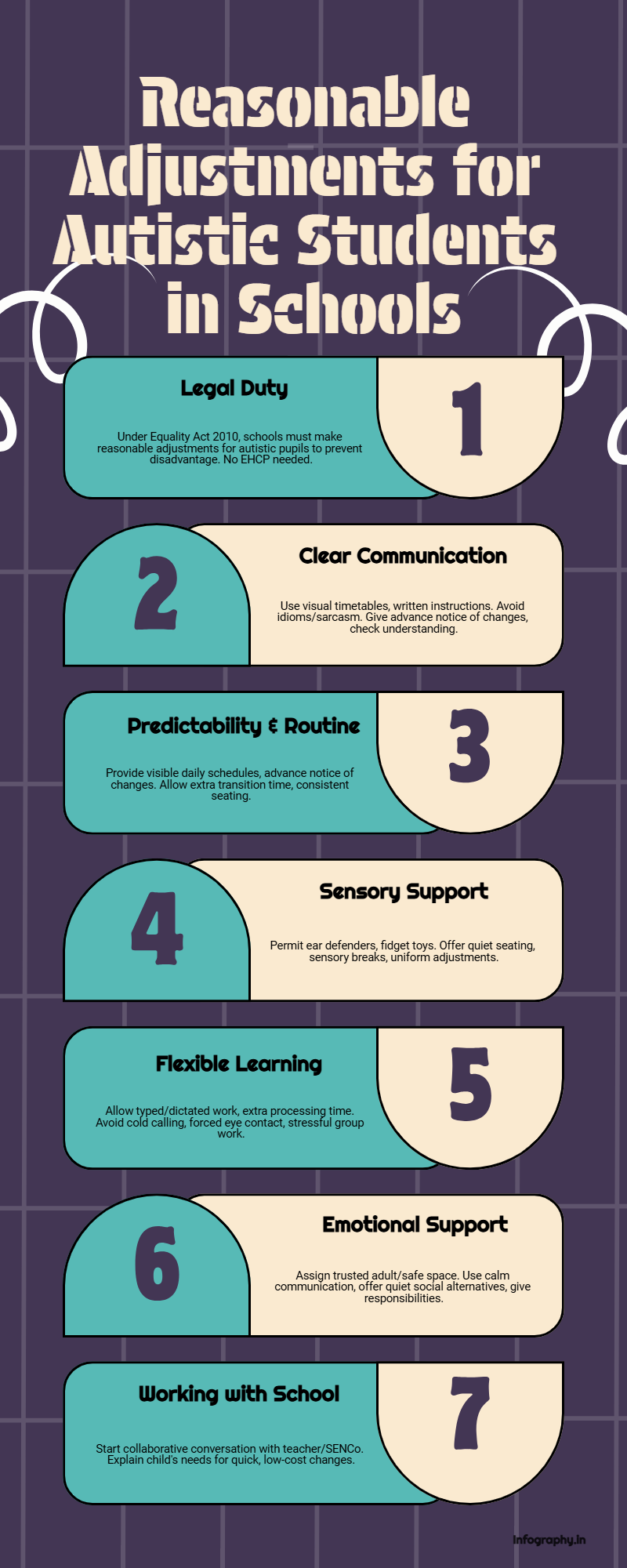
Reasonable Adjustments in Schools for Autistic Students
Simple, low-cost changes that can make school life easier
Every child deserves to feel safe, supported, and understood at school — and for autistic students, that often means making a few simple changes to help them thrive.
Under the Equality Act 2010, schools have a legal duty to make reasonable adjustments for disabled pupils, including those who are autistic. These adjustments ensure that your child isn’t placed at a disadvantage compared to others — and many of them cost little (or nothing) to put in place.
This isn’t about asking for special treatment. It’s about helping your child access learning in a way that works for them.
What Are Reasonable Adjustments?
“Reasonable adjustments” are practical steps a school can take to reduce barriers that make learning harder for your child. What’s considered reasonable depends on:
your child’s individual needs,
the school’s size and resources,
and how easily the adjustment can be made.
Most importantly, these adjustments are meant to help your child feel calm, capable, and included — not singled out.
Examples of No-Cost or Low-Cost Adjustments
Clear Communication
Use of visual timetables or written instructions.
Avoiding idioms or sarcasm; keeping communication clear and direct.
Providing reminders or prompts for key parts of the day.
Letting them know in advance of upcoming changes
Checking their understanding after a task is set
Predictability & Routine
Giving advance notice of timetable changes or special events.
Having a visible daily schedule.
Allowing extra time for transitions between activities.
Keeping seating arrangements the same
Sensory Support
Allowing ear defenders or fidget toys.
Seating your child somewhere with minimal noise or visual distractions.
Offering short sensory or movement breaks or access to a calm, quiet space.
Allow adjustments to uniform
Flexible Learning Approaches
Allowing work to be typed or dictated instead of handwritten.
Giving extra processing time to answer questions.
Not “cold calling” them in lessons (i.e asking them a question in front of the class)
Avoiding forced eye contact or group work if it causes stress.
Emotional & Social Support
Assigning a trusted adult or safe space your child can go to when overwhelmed.
Using calm, consistent communication.
Offering social alternatives — like quiet lunch clubs or supervised down-time.
Give them a job/responsibility to do on arrival at school – lay out pens, taking registers to classes.
Working with Your Child’s School
You don’t need to have an Education, Health and Care Plan (EHCP) to ask for reasonable adjustments. If your child is struggling with anxiety, meltdowns, or sensory overwhelm, these supports can often be put in place quickly by the class teacher or SENCo.
The best approach is to start a collaborative, respectful conversation with the school — explain what helps your child and what specific changes would make a difference.
Template Email for Parents
Here’s a gentle but assertive email you can adapt when reaching out to your child’s school:
Subject: Request for Reasonable Adjustments for [Child’s Name]
Dear [Teacher’s Name / SENCo],
I hope you’re well. I’m writing to discuss some reasonable adjustments that could help support [Child’s Name] in school. As you know, [he/she/they] is autistic and sometimes finds certain aspects of the school day challenging.
Many of these adjustments are small, practical changes that can make a big difference.
Here are a few ideas that could help [Child’s Name]:
[List 3–5 relevant adjustments, e.g. use of visual timetable, quiet space at breaktime, notice of timetable changes, access to fidget toy, etc.]
I’d really appreciate the opportunity to meet and discuss what’s possible so we can work together to help [Child’s Name] feel comfortable and confident at school.
Thank you so much for your time and understanding. Please let me know when would be a good time to meet or speak.
Kind regards,
[Your Name]
[Your Contact Information]
Final Thoughts
Advocating for your child doesn’t have to be a battle — it’s about working in partnership with the school so your child feels understood, supported, and happy to learn.
Remember: small adjustments can make a huge difference. And as a parent, you’re the expert on what your child needs — your voice matters.

How to be a confident parent.
Throwing out the parenting guides!

When my child was a baby, I read all the books — the sleep routines, the feeding guides, the “do this, not that” manuals. Each one had a different method. Each one promised it was the right way. I remember feeling completely confused and overwhelmed by all the mixed messages. In the end, I physically threw all the books in the bin and decided to do it my way.
Since my child’s diagnosis, that decision has become even more important.
I parent differently to how I was parented.
I parent differently to my friends who have neurotypical children.
I know they sometimes think I’m too soft… or too strict.
And yes, I do things as a parent of an autistic child that other parents might be horrified by.
But here’s the thing — I’ve learnt not to care.
I parent my child in the way they need to be parented, and in the way that works for us.
So…
If they need their iPad to regulate — I won’t be confiscating it.
No, we don’t visit Father Christmas. They’d hate it.
If they want to eat dinner in their bedroom because they’re dysregulated — so be it.
If they need an occasional duvet day from school to reset — so be it.
If they want to do homework sitting on the kitchen floor — so be it.
These are your children. This is your parenting journey.
You know your child better than anyone. Have confidence in the way you choose to meet their needs.
And if anyone questions it, just smile and say:
“We do what works for us.”
At Family Avenues, we believe there’s no one-size-fits-all approach to parenting — just the one that works for you and your child.

Our favourite books for parents of neurodivergent children
The best books you need about Autism
For this picture blog, we’ve pulled together a list of our favourite (and most recommended) books for parents.
p.s There are never ads or affiliates in our blogs, just our honest recommendations!