

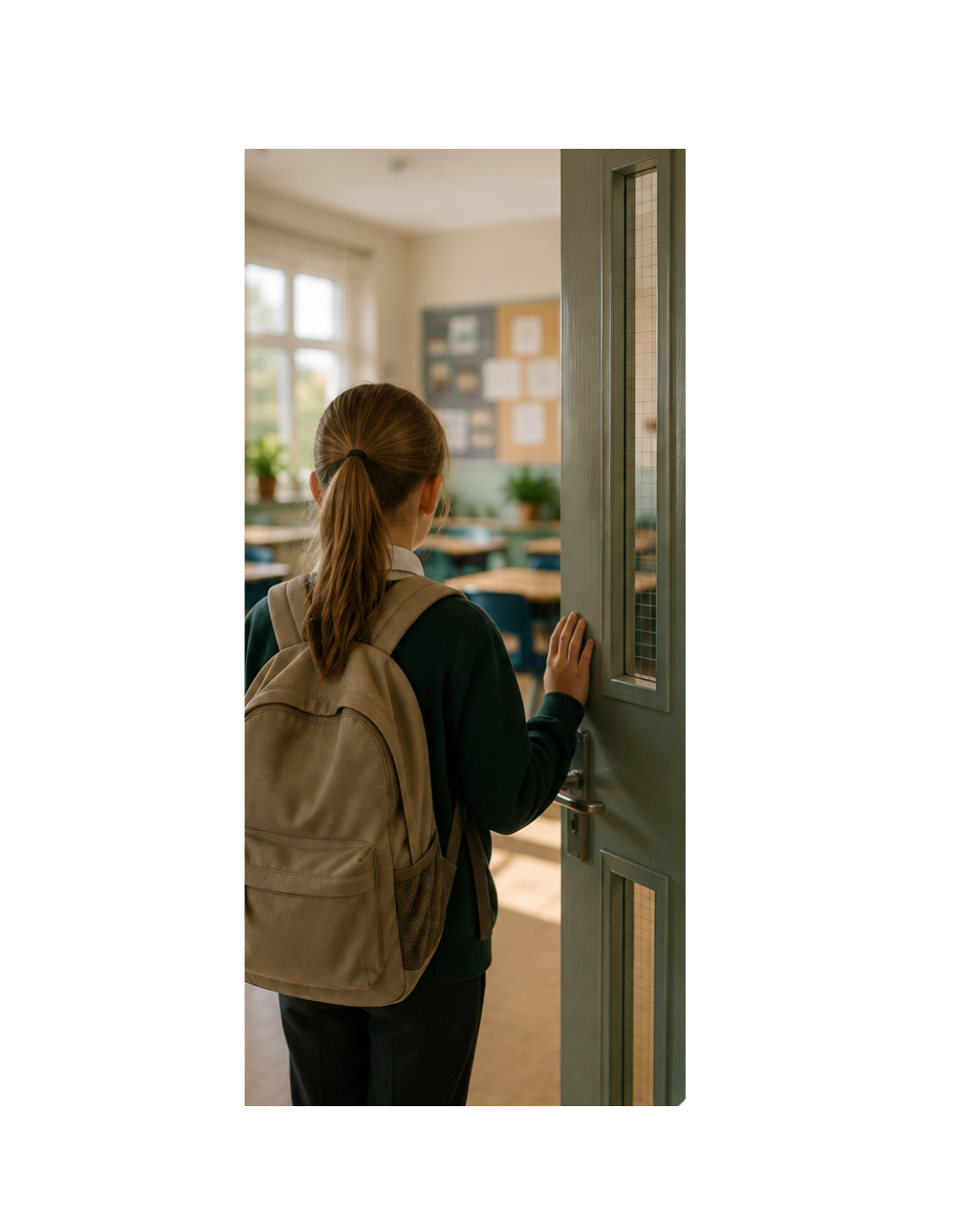
Before they Walk In
Small classroom changes that help pupils feel safe, calm and ready to learn.
Before the register. Before the lesson. Before a single word. A child has already begun to experience your classroom.
A child entering your room brings with them experiences, interactions and a learning profile that may not be immediately obvious to you. Creating a calm, accessible and inclusive classroom environment that allows some autonomy, natural movement and different ways of learning and regulating can help pupils feel more comfortable and ready to engage. It can also help create the conditions you need to do the teaching you do so well.
The ideas in this blog invite you to look at your room and consider whether one small change could soften the environment. They will not remove the need for teacher-led support or intervention. However, they may reduce some of the pressure that can show itself through verbal interruptions, difficulty engaging, repeated movement or leaving the room. For pupils with a PDA profile, having safe and appropriate opportunities for autonomy may make the classroom feel easier to manage.
This is not a one-size-fits-all checklist of tasks or things every classroom should have. Search for classroom setup ideas or a SEND-friendly classroom and you will find countless recommendations: visual timetables, movement breaks, busy displays, minimal displays, calm corners and flexible seating. The reality is that no single approach will create the right environment for every pupil, teacher, subject or space.
Teachers also bring their own needs into the room. You may have sensory sensitivities, particular triggers around behaviour and your own ways of working effectively. A classroom adjustment that supports pupils but makes it significantly harder for you to teach is unlikely to be sustainable. This blog is not designed to create more work. It is designed to help you recognise what you already do well, look at the room from your pupils’ perspectives and choose one small change to try.
Observe → Reflect → Experiment → Keep, Adapt or Scrap.
Try the change, notice what happens and ask pupils what difference, if any, it made. Keep what helps, adapt what might work differently and scrap what adds pressure without bringing value.
What is your classroom communicating?
None of this will be news to teachers. It can be incredibly frustrating when the things affecting a room are outside your control. Perhaps the seating is fixed. Maybe you teach in several different rooms and carry your resources around with you. Perhaps you have the really difficult-to-engage class, who are not remotely interested in your subject, last thing on a Friday and you dread it more than they do.
You may not be able to redesign the space, change the timetable or move the school kitchen. That doesn’t mean there is nothing you can do. Sometimes it is about looking at the room you have and thinking creatively about what might soften it.
At Family Avenues, we often talk about behaviour as communication. Here, we want to explore what the room is communicating to the pupils who enter it. Do they feel welcome? Do they feel safe? Do they feel seen and understood?
Guidance from the Education Endowment Foundation connects positive, supportive environments with stronger relationships, active engagement and a more proactive approach to behaviour. It also asks schools to consider students’ experiences in the corridors and other spaces between lessons - not only what happens once they are seated in the classroom.
One thing we hear consistently from autistic children and young people is how difficult the sensory overload of moving around school can be. Noisy corridors, physical contact, crowds, unpredictable interactions and the pressure to reach the next room on time can all add up.
If a student enters your room already feeling fizzy from the journey there, their internal safety alarms may already be sounding. When the nervous system is heightened, it can become harder to process new information, respond to demands, organise equipment or work out what is expected. This is why it matters
Imagine that you are running late for a staff meeting. You have not had time to nip to the loo. Several people have bumped into you while you were trying to get there, and you arrive feeling flustered and conspicuous. What would you need when you entered the room?
Would somebody pointing out that you are late in front of everyone help you settle? Or would a gentle, “Hi. Take your space and get yourself settled. We’re just beginning,” make it easier to join the meeting?
The expectation has not disappeared. You still need to join the meeting. But the way you are received can either increase the pressure or help you become ready to engage.
A sensory-friendly classroom does not mean the same thing for everyone
I wish I could give you a one-size-fits-all checklist for creating the perfect classroom: work through it, tick every box and magically find yourself surrounded by calm, comfortable and engaged pupils. Imagine how powerful that list would be.
The reality is more complicated. Teachers are often under pressure to create fabulous displays and fill classrooms with information that supports learning. But what if some of that useful information, or those gorgeous displays you spent hours creating, is also acting as a distraction for some of your pupils?
A 2026 experimental study involving 47 primary-aged children found that classroom displays increased off-task behaviour, with a stronger effect for the autistic pupils involved. A recent systematic review has also linked particular noises, lighting and visual distractions with poorer learning or wellbeing for some autistic students.
These findings add weight to the need to take sensory load seriously. However, they do not tell us that every colourful display is wrong, that every classroom should be stripped bare or that every autistic pupil needs the same environment.
This is where observation and student voice matter.
Gentle music might soften an uncomfortable silence for one class and add another layer of noise for another. A quieter table may be exactly what one child needs but feel exposing or isolating to somebody else. Adjustments are tools, and their usefulness depends on the pupil, the task and the room.
I would also encourage you to notice your own sensory needs. Teachers have nervous systems too. Are there sounds, movements or repeated behaviours that make it harder for you to remain calm and think clearly? What might help you manage that experience?
If it feels comfortable, you can explain what an adjustment helps you to do. This normalises support, demonstrates that different people need different things and models the self-awareness and self-advocacy we often ask of our pupils.
The aim is not to create a classroom in which nobody is ever distracted, uncomfortable or dysregulated. It is to notice what the environment is asking of everyone in it, including you, and consider whether one small change might make that demand easier to manage.
Primary and secondary classrooms are different—but the needs do not disappear
In a primary classroom, children may spend much of the day in one main room with a smaller group of familiar adults. This can make it easier to build movement, different ways of working and accessible support into the room and the class day.
It makes sense to explore that room together. Where is it easiest to listen? Where can bodies move safely? How can a child ask for help? Is the “quiet area” also expected to be the “calm area”, even though working quietly and regulating an overwhelmed nervous system may be two very different needs?
Secondary classrooms work differently. Young people move between rooms, teachers, subjects, peer groups and sets of expectations. Support cannot always be attached to one chair, one table or one familiar adult. Before your lesson, they may already have managed several different environments, social interactions, corridor transitions and demands. The first five minutes of your lesson sit at the end of that journey, not at the beginning of it.
Support does not become unnecessary in secondary school, but it may need to be offered differently: in a way that is age-respectful, acceptable to the young person and workable within the subject and classroom.
Age-respectful support is still support. Growing older changes how we offer it; it does not remove the underlying need.
Ask the students who use the room
Student voice can show us things about the room that we might otherwise miss.
It does not need to become a lengthy consultation. The Primary and Secondary Classroom Environment Reflection Tools include simple prompts to help pupils share what supports learning and what makes it harder.
Children might draw, point, choose a colour or ask an adult to record their words; older pupils may prefer to respond anonymously. Nobody needs to disclose a diagnosis or personal experience publicly for their view to count.
Tell pupils what will happen to their feedback, be honest about what cannot change and choose one pattern to explore.
Observe → Reflect → Experiment → Keep, Adapt or Scrap.
This is not about introducing an adjustment and then defending it forever. It is an experiment.
Observe: What is happening, and when?
Reflect: What might the pupil or class be experiencing?
Experiment: Try one small, realistic change, notice what happens and ask pupils what difference, if any, it made.
Keep, adapt or scrap: Use what you have learned.
An idea doesn’t have to work to be useful. If a change makes concentration harder, scrap it. If it is ignored, ask why and adapt it. If it helps, keep it and notice whether it continues to help.
Come back to the question once a term. Children change. Rooms change. Relationships change. What works in September may need adjusting by January.
Continue the reflection with Family Avenues
The Before They Walk In cards hold the reflection; this blog explores the evidence and lived experience behind it; and the free tools help you turn that thinking into one small experiment. We created separate Primary and Secondary Classroom Environment Reflection Tools because the environments—and pupils’ journeys into them—are genuinely different.
Get the free Primary Classroom Environment Reflection Tool — exploring learning, movement, asking for help and regulation.
Get the free Secondary Classroom Environment Reflection Tool — following the journey between lessons and into the first five minutes in the room.
Choose one idea from the resource—or create an experiment of your own—then observe, reflect and decide whether to keep, adapt or scrap it.
Talk to Family Avenues about professional consultation
If you would like to explore a particular classroom, transition, trigger point, learning need or distressed behaviour, Family Avenues offers professional consultations for schools. We bring professional knowledge and lived experience together to help you understand what may be happening and identify realistic next steps.
Evidence and further reading
Education Endowment Foundation (2020), Special Educational Needs in Mainstream Schools: https://educationendowmentfoundation.org.uk/education-evidence/guidance-reports/send
Education Endowment Foundation (2024), Build a culture of community and belonging for pupils: https://educationendowmentfoundation.org.uk/education-evidence/leadership-and-planning/supporting-attendance/build-a-culture-of-community-and-belonging-for-pupils
Department for Education (2021), Supporting SEND: https://www.gov.uk/government/publications/supporting-send/supporting-send
Department for Education and Department of Health and Social Care, SEND Code of Practice: 0 to 25 years: https://www.gov.uk/government/publications/send-code-of-practice-0-to-25
Jones, E. et al. (2026), The Effect of the Classroom Sensory Environment on Engagement for Autistic Pupils: https://doi.org/10.1177/27546330261443570
Melguizo-Ibáñez, E. et al. (2026), Classroom Active Breaks as a Physical-Educational Intervention for Executive Functions and Mathematical Outcomes: https://doi.org/10.1007/s10648-026-10146-3

Is My Child's Bladder or Bowel Development Normal? A Parent's Guide to Knowing When to Seek Help
We are thrilled to bring you our first (but definitely not last) guest blogs. Today’s blog is written by Vicky Stables from HealthyB’s. I reached out to Vicky as so many parents were telling us that their children had bowel or bladder issues yet were not getting the support that they needed. So a huge thank you to Vicky for writing this. You’ll find her at healthybs.co.uk

As parents, we spend years celebrating milestones – first smiles, first steps, first words. But when it comes to toilet training and staying dry, it can be much harder to know what is "normal."
Many parents worry that they've done something wrong if their child is still wetting themselves, having accidents, or wetting the bed. Others assume their child will simply grow out of it.
The truth is this:
Children do not wet themselves because they're lazy.
They are not being ‘naughty’ or doing it for attention.
Likewise, parents do not cause bladder or bowel conditions by getting toilet training "wrong."
Bladder and bowel difficulties happen for many different reasons, including physical development, constipation, genetics, medical conditions and how the bladder functions.
Bladder and bowel problems are incredibly common, they're treatable, and they are never anyone's fault.
Not your child's.
Not yours.
And…with the right support, most children can make significant improvements.
What's considered normal?
Every child develops at their own pace, but there are some general milestones that healthcare professionals use.
Daytime dryness
Most children become reliably dry during the day between 2½ and 4 years old, although some take a little longer.
By the time children start school, most are able to stay dry throughout the day. However, occasional accidents are still perfectly normal, particularly if they're busy playing, unwell or experiencing a big life change.
Night-time dryness
Night-time dryness develops much later than daytime dryness.
Many children continue to wet the bed after they've mastered daytime toileting because staying dry overnight depends on physical development that cannot be rushed.
Healthcare professionals generally don't consider bedwetting to be a medical problem until a child is 5 years old or older.
Even then, bedwetting is very common. Millions of children experience it, and many simply need a little extra support.
When should I seek help?
It's worth speaking to a healthcare professional if your child:
· is 5 years or older and regularly wets the bed
· is having daytime wetting accidents after becoming dry
· has never achieved daytime dryness by school age
· needs to wee extremely frequently or very rarely
· experiences urgency and struggles to reach the toilet in time
· complains that weeing hurts
· has repeated urine infections
· is soiling their underwear regularly
· has constipation or painful pooing
· is avoiding drinking because they're worried about accidents
· is becoming anxious, embarrassed or reluctant to attend school because of their bladder or bowel.
Trust your instincts too. If you're worried, it's always okay to ask for advice.
But my child is neurodiverse so won’t it be different for them?
The short answer is yes and no.
Children who are neurodivergent, including those with ADHD, autism, learning disabilities or other additional needs, are more likely to experience bladder and bowel difficulties than their peers. There are lots of reasons for this. Some children may find it difficult to recognise when their bladder or bowel is full, while others become so focused on what they're doing that they don't notice the urge to go to the toilet until it's too late. Sensory differences can also make some children avoid certain toilets, particular clothing or even the feeling of using the toilet itself. Constipation is also more common in some neurodivergent children and can have a significant impact on bladder function.
However, it's important not to assume that every bladder or bowel problem is simply "part of their diagnosis."
Children who are neurodivergent can still develop constipation, overactive bladders, urinary tract infections and other conditions that deserve assessment and treatment. Assuming that accidents are "just because they're autistic" or "just because they have ADHD" can sometimes delay children getting the help they need.
The same milestones and guidance about when to seek support still apply, but your child may benefit from approaches that are tailored to how they learn and communicate. For example, visual schedules, regular reminders, sensory-friendly toilet environments or personalised routines can all make a real difference.
Above all, remember that your child's neurodiversity does not mean they should simply have to live with bladder or bowel problems. With the right understanding and support, many neurodivergent children make significant progress.
Where can I get help?
Your first step is usually your GP or health visitor (for younger children). School-aged children may also be supported by their local School Nursing Service, depending on where you live.
Many areas also have specialist children's bladder and bowel services that can assess your child and provide personalised advice and treatment. Referrals for these teams are usually through the GP, School Nurse or Health Visitor. One of the UK's best sources of trusted information is ERIC, The Children’s Bowel and Bladder Charity. Their website offers practical advice, downloadable resources and guidance for parents, children and professionals. You don't have to struggle alone.
Don't underestimate the role of school
Many parents worry about telling school that their child has bladder or bowel difficulties.
They may feel embarrassed, worry their child will be singled out, or assume there's nothing school can do.
Children spend around six hours a day in school. Consistency between home and school gives them the best chance of succeeding.
When school understands what's happening, staff can often:
· allow regular toilet breaks without drawing attention to your child
· ensure your child has easy access to drinking water
· provide discreet support if accidents happen
· help reduce anxiety around using school toilets
· make reasonable adjustments where appropriate
· work alongside healthcare professionals to support treatment plans.
If your child has been assessed by a healthcare professional, sharing recommendations with school helps everyone work together towards the same goals.
You are not alone
Bladder and bowel difficulties affect thousands of families across the UK every single day.
Although it can sometimes feel isolating, help is available and effective treatments exist.
If you're worried about your child, don't wait until they're "old enough to grow out of it." Start a conversation with your GP, School Nursing Service or school, and explore the excellent advice available from ERIC. At Healthy Bs – Bladders, Bowels & Bathrooms, we can hold your hand through the process, help you to approach health professionals or the school and generally be there for any bumps in the road. Find out more at www.healthybs.co.uk
No child should feel ashamed of having a bladder or bowel condition, and no parent should feel they're facing it alone.
Authored by:
Vicky Stables from Healthy Bs – Bladders, Bowels & Bathrooms! www.healthybs.co.uk

I get it, she’s a lot, but……
What happens when a child learns that being themselves gets them into trouble? This blog explores the hidden cost of masking and why understanding neurodivergent children matters so much.
Often, when I find myself advocating for my daughter after someone has mishandled a situation, I find myself pre-facing it with ‘I get it…’
And I do get it. My daughter has ADHD. She can’t take medication for it because it exacerbates her OCD. She is also Autistic and doesn’t pick up on social cues when she is being ‘too loud,’ ‘too impulsive,’ ‘too hyper,’ ‘disruptive,’ ‘unfiltered.’ The list goes on.
But when people mistake all of this for being ‘overconfident’ they think she can handle it when they get frustrated with her. And she absolutely cannot.
Masking is something ADHD girls in particular are expert at. When my daughter was being assessed her teacher wrote on the school forms that she ‘has no trouble sitting still and in the classroom you wouldn’t know she was there as she is so quiet.’ I cried when I read that because that does not describe my daughter at all. I knew the amount of effort going into sitting still and not drawing attention to herself had already come at a significant expense and as a result she was now in burnout and we were scrambling to learn how to help her recover.
Since then, my daughter’s primary school had a better understanding of her needs. She stopped going to the clubs she had previously enjoyed because she was so worried about being told off if she got excited. We joined a group for Autistic girls where she could be herself. A huge amount of effort and resources has gone into accessing the right mental health support for her and an educational environment that can meet her needs when she starts secondary school in September.
A couple of months ago, for the first time in three years, I found myself saying ‘It’s like she’s her old self again.’
Because she was so relaxed, regulated, and genuinely cheerful. She was playing out with children on our street on their scooters, happily skipping off to school in the mornings, singing loudly without even realising and we were not seeing the distressing evidence of anxiety that had become part of daily life. Nothing makes me happier than seeing my child thriving. That is all any parent wants. And my daughter’s personality is what makes her sparkle and we love her so much for it.
However, we then saw the cycle again where people (peers and adults) would get frustrated with her and she would get into trouble. For being happy. Not because she was doing anything wrong. Not because she was ever remotely unkind.
And no matter how much I preface my advocacy with ‘I get it but…’ the reality is what I was about to say constitutes to ‘you caused her significant distress for something she literally cannot control.’ And that absolutely breaks my heart.
Because, every time something happens where she has been excited, happy, impulsive, noisy, and she has been told she is ‘disrespectful’ or ‘hurting my ears’ or ‘not listening,’ what she takes from that is that she let the mask slip and she must fix it back on in order to protect herself.
That might make those people feel more content around her. But that mask is unsustainable for her nervous system.
So; whether you are the relative, friend, teacher or any other professional… If you are lucky enough to have a sparkly ADHD child in your life – please look beyond their presentation and don’t mistake ‘confidence’ for being able to receive negative feedback from you.
Redirect them, or gently explain something to them without embarrassing them.
But please, please, don’t dim their sparkle.

Holidays: why they feel harder than staying at home (and what actually helps)
There’s a narrative that holidays are meant to be the “easy bit.” The break. The recharge. The part where everything slows down and family life suddenly becomes soft-edged and sunlit.
For my family, that has rarely been the reality. More often, holidays are harder than staying at home. Not in a dramatic, Instagram-unfriendly way. Just in a layered, cumulative, constantly-adjusting kind of way that takes more energy than people expect.
Change is difficult. Even “nice” change. New environments, new beds, new sounds, new routines, new layouts of space and time. What looks like freedom on paper often feels like cognitive overload in practice. For neurodivergent kids (and honestly, neurodivergent adults too), there is no “holiday mode switch” that suddenly makes flexibility easy.
Then there’s the weather. Hot weather sounds like a bonus until it becomes another sensory demand. Too bright, too warm, too sticky, too much clothing or not enough structure to the day. Everyone slightly unravelled in different directions at the same time.
Crowds don’t help either. Places that are designed to be enjoyable become unpredictable obstacle courses of noise, queues, waiting, bumping, rushing, and overstimulation.
And underneath all of that is the real work most parents are doing quietly: managing multiple neurodivergent needs at once. Different thresholds. Different triggers. Different recovery times. Different needs for control, space, reassurance, food, movement, quiet, connection. It’s like running several nervous systems on different operating systems in the same small space.
Last summer, my eldest refused to go on holiday at all. That wasn’t a “behaviour” problem. It was a capacity decision. A nervous system saying: I can’t add this on top of everything else. And once you understand it like that, it changes how you see the whole idea of “family holiday success.”
So what actually helps? One of the biggest shifts for us has been letting go of the idea that holidays have to look different every time.
Going to the same place repeatedly has been unexpectedly powerful. Familiarity reduces load. The more predictable the environment, the less energy is spent decoding it. It becomes less about “new experience!” and more about “we know how this works.” That shift alone can make the difference between meltdown and manageable.
Timing matters more than people realise too. Out-of-season travel, or at least avoiding peak school holidays where possible, changes everything. Not just price, but pace. Fewer people, less pressure, more space to exist without constant negotiation with the environment.
There’s also something important in the legal and practical reality of school attendance that families don’t always feel empowered to use: schools can authorise absence for exceptional circumstances. Holidays don’t automatically have to be unauthorised if there is a genuine wellbeing need, and it is always worth having that conversation early, clearly, and in writing. Not as a confrontation, but as collaboration around a child’s capacity and family functioning. For neurodivergent children in particular, predictability of breaks that work for them can be protective rather than disruptive.
Accommodation choice also matters more than I ever used to think it would. Hotels often sound convenient, but they can amplify overload: shared corridors, breakfast rooms, noise at all hours, lack of control over space.
An Airbnb or similar self-contained space can be the difference between coping and not coping. Having a “home-from-home” means there is somewhere to decompress that isn’t constantly socially or sensory loaded. A kitchen. A door you can close. A space that belongs to you for the week, even if everything else feels unfamiliar.
Airports and travel hubs are their own category of challenge. The Hidden Disabilities Sunflower lanyard scheme, run by Hidden Disabilities Sunflower, has genuinely made a difference for us. Not magically easier, not stress-free—but more understood. More pauses offered. More staff awareness. More permission to take things at a different pace without having to explain everything repeatedly in moments when you don’t have the words for it.
And then there’s the invisible tension that sits underneath all of this: cost versus reward. Because holidays are expensive. Financially, emotionally, and in preparation load. And when things go well, they can feel absolutely worth it. But when they don’t, the question lingers afterwards: was that worth the energy it took to get there?
For me, the most honest version of planning now includes that question upfront. Not as pessimism, but as realism. What is the likely return on emotional and sensory investment? What level of disruption can we actually absorb right now? What needs to be in place for this to be survivable, not just aspirational?
And then there’s the parental organiser role. The invisible job that doesn’t stop just because you’re not at home. Packing, planning, anticipating, problem-solving, regulating everyone else’s regulation, carrying the “what ifs,” managing the expectations of others while quietly tracking the capacity of your own family system in real time.
That role doesn’t go on holiday.
So when I think about what actually makes holidays possible for families like ours, it isn’t about perfection or escape. It’s about reducing unknowns. Increasing familiarity. Building in recovery space. Choosing environments that flex with us instead of forcing us to flex constantly.
And redefining success.
Sometimes success is a magical week of memories.
Sometimes it’s just getting through without anyone hitting burnout.
Both count.
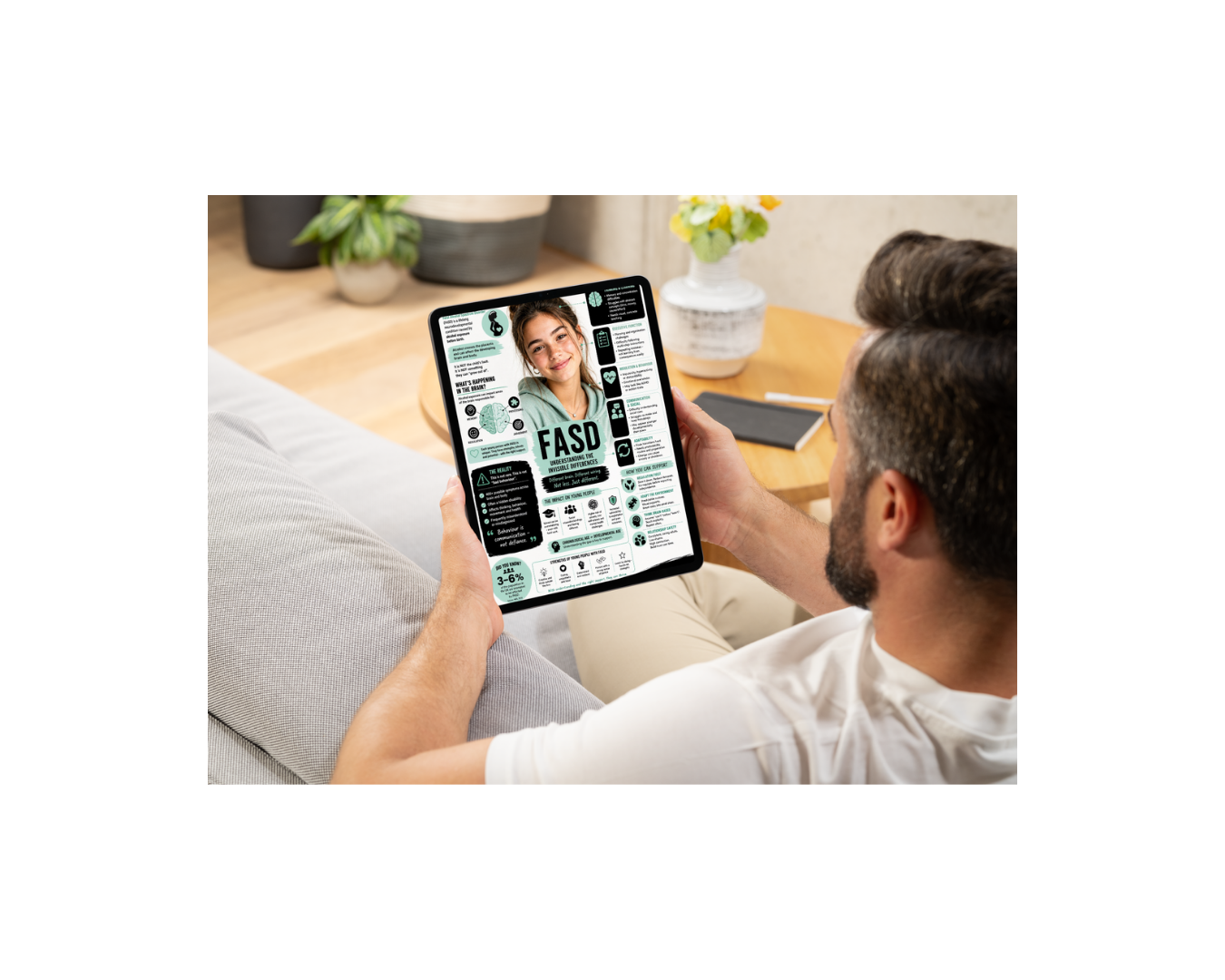
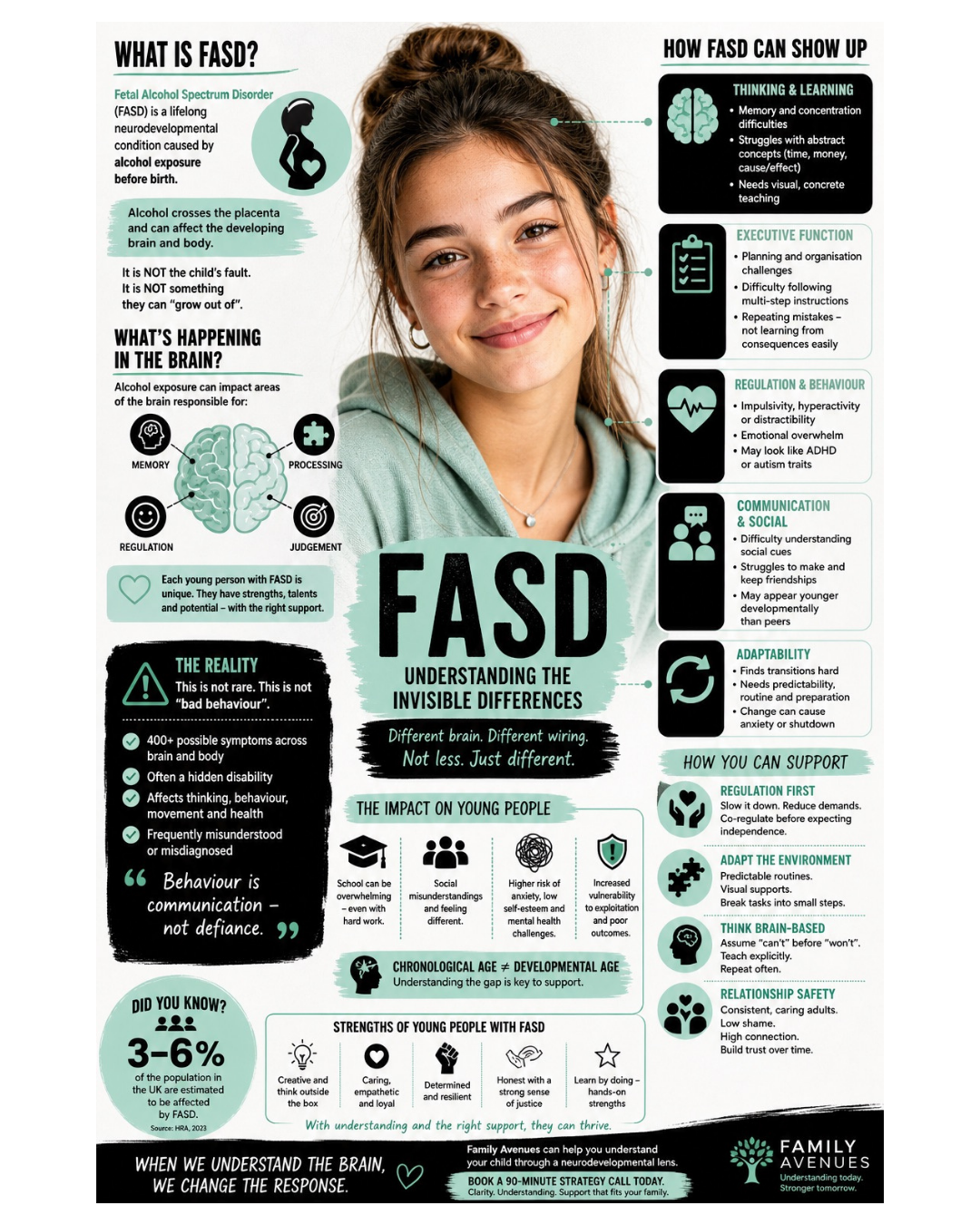
FASD: Understanding the Invisible Differences
There are children and young people walking into schools every day who are trying their absolute best… and still being misunderstood. Not because they won’t, but because their brains work differently.
One of the most overlooked reasons for this?
Foetal Alcohol Spectrum Disorder (FASD).
What is FASD?
FASD is a lifelong neurodevelopmental condition caused by alcohol exposure during pregnancy.
Alcohol crosses the placenta and can affect the developing brain and body at any stage of pregnancy — often before someone even knows they are pregnant.
FASD isn’t always visible. You won’t necessarily “see” it in the way people expect. But it can impact:
Memory and processing
Emotional regulation
Impulse control
Understanding consequences
Social communication
Which means what often gets labelled as:
“defiance”
“attention seeking”
“lazy”
“not trying”
…is very often something else entirely.
It’s brain-based. Not behaviour-based.
What Causes FASD?
FASD is caused by prenatal exposure to alcohol.
And this is where we need to be really clear — because this is where the myths do damage.
It is not just caused by:
heavy drinking
alcohol dependency
repeated high consumption
FASD can occur when:
alcohol is consumed before pregnancy is known
drinking happens occasionally or socially
exposure happens at critical points in brain development
There is no known safe amount of alcohol in pregnancy. And crucially:
It is not always about “heavy drinking”
It can happen in pregnancies where there was no intention to cause harm
It is often linked to lack of awareness, mixed messaging, or timing
Let’s Gently Dispel a Harmful Myth
There’s a narrative that FASD only happens in “extreme” situations.
That it’s rare.
That it’s obvious.
That it’s someone else’s story.
That narrative stops recognition.
And when we don’t recognise it — we misinterpret it.
Some people believe:
“Surely one drink won’t matter.”
The truth is more uncomfortable. We cannot predict how alcohol will affect a developing brain. We don’t know what amount may cause harm in any individual pregnancy. Which is why the guidance is clear:
No alcohol = no risk.
But this isn’t about blame. Because many parents:
didn’t know they were pregnant
weren’t planning/trying to conceive
were given conflicting advice
were told small amounts were “fine”
So instead of blame, we need understanding.
How Common is FASD?
FASD is more common than most people realise.
In the UK, estimates suggest:
Around 3–6% of the population may be affected
That’s potentially 1 in every classroom
Yet it remains:
underdiagnosed
misunderstood
often mislabelled as ADHD, autism, trauma, or “challenging behaviour”
Sometimes it sits alongside those — sometimes it’s missed entirely.
The Impact on Children and Young People
For a child with FASD, the world can feel confusing and unpredictable.
You might see:
big emotional reactions that seem to come “out of nowhere”
difficulty following multi-step instructions
repeating the same mistakes despite consequences
struggles with friendships
anxiety or shutdown when things change
And over time? Without understanding, that can turn into:
low self-esteem
school avoidance
exclusion
mental health difficulties
Not because they can’t thrive, but because the environment hasn’t adapted to them.
Can FASD Be Prevented?
Yes — in a very clear, simple way:
By avoiding alcohol during pregnancy.
But prevention isn’t just about individual choices.
It’s about:
clear, consistent public health messaging
removing mixed advice (“a little is fine”)
supporting people before and during pregnancy
reducing stigma so conversations can happen openly
Because silence and shame don’t prevent FASD, information and support do.
What Actually Helps?
When we understand the brain, everything changes.
Support isn’t about stricter boundaries or harsher consequences.
It’s about:
co-regulation before expectation
simplifying and breaking down instructions
repetition without shame
predictability and routine
reducing overwhelm in the environment
And most importantly seeing the child, not just the behaviour.
A Final Thought
Children with FASD are often described as:
kind
funny
determined
full of potential
But they are also often the children who get misunderstood the most because their differences are invisible. So when we shift from “What’s wrong with them?” to “What’s going on in their brain?”, we don’t just change how we respond, we change their entire experience of the world.
Need Support?
If you’re a parent or professional trying to make sense of behaviour that doesn’t quite “fit” — you’re not alone.
At Family Avenues, we help you understand what’s underneath the behaviour and what actually helps.
Our 90-minute Direction Call gives you clarity, practical strategies, and a way forward that fits your family.
Organisations offering FASD support:

All things Stimming

More than what it looks like
When people hear the word stimming, they often picture hand flapping or rocking.
And yes — those are forms of stimming.
But that’s only part of the picture.
Stimming (short for self-stimulatory behaviour) is something many autistic people — and neurodivergent people more broadly — use to regulate their emotions, process sensory input, and feel more in control of their environment.
It isn’t just something children do. It isn’t always obvious. And it isn’t something that needs to be “stopped”.
What is stimming?
Stimming refers to repetitive movements, sounds, or behaviours that help a person regulate.
This might be:
• calming themselves when overwhelmed • focusing or concentrating • expressing excitement • managing anxiety • or simply doing something that feels good
For many, it’s a natural and essential way of coping.
It doesn’t always look how you expect
Some stimming is easy to recognise.
But much of it is subtle — especially in older children and adults.
More obvious stimming
• Hand flapping • Rocking • Spinning • Repeating sounds or phrases • Jumping or pacing
Less obvious stimming (often missed or misunderstood)
• Twirling or playing with hair • Picking at skin, nails, or clothing • Chewing on pens, sleeves, or inside of cheeks • Tapping fingers or feet in patterns • Clicking pens or opening/closing objects repeatedly • Rubbing fabrics, labels, or textures • Re-reading the same sentence or paragraph • Doodling repetitive patterns • Listening to the same song or sound on repeat • Shifting posture frequently
These behaviours are often seen as habits, fidgeting, or even “distracting behaviour” — but they are often doing an important regulatory job.
Stimming in adults
Many adults still stim — but it may look different.
Over time, people often learn to mask or adapt their stimming so it appears more socially acceptable.
This might look like:
• tapping a foot under the table • fiddling with jewellery • using a phone or scrolling repeatedly • drinking or smoking more frequently • needing constant background noise
Sometimes, adults don’t even realise they are stimming — they just know certain things help them feel calmer or more focused.
Why stimming matters
Stimming is not “bad behaviour”.
It is:
👉 communication 👉 regulation 👉 a coping strategy
When we try to stop stimming without understanding it, we risk removing something that is helping the person manage their environment.
Do we ever need to worry?
In most cases, no.
Stimming is a healthy and important part of regulation.
However, it may need more attention if:
• it is causing physical harm (e.g. skin damage, hair pulling) • it is causing significant pain • it is putting the person or others at risk
Even then, the goal isn’t to stop the stimming entirely — it’s to understand the need behind it and support safer alternatives.
What actually helps
The most helpful starting point is curiosity.
Rather than asking:
👉 “How do I stop this?”
Try asking:
👉 “What might this person need right now?”
Helpful approaches
✔ Allow safe stimming If it isn’t causing harm, it’s often best to let it be.
✔ Look for patterns When does it happen? What’s going on just before?
✔ Reduce overwhelm Stimming often increases when environments feel too much.
✔ Offer alternatives (if needed) Fidget tools, chewable items, or sensory objects can help where behaviours are causing discomfort.
✔ Support regulation proactively Movement breaks, quiet time, or sensory input before things escalate.
✔ Respond with curiosity, not correction This shift alone can change everything.
A final thought
Not all stimming is visible. Not all stimming is understood.
But for many people, it is an essential part of how they move through the world.
When we begin to see stimming not as something to stop, but as something to understand, we move closer to supporting people in a way that truly meets their needs.
At Family Avenues
We support families and professionals to better understand behaviour, reduce overwhelm, and find strategies that work in real life.
👉 Explore our free resource hub or services to find out more.

Building Your Own Village

When we’re asked what support we have around us, we often think about family — or friends who visit.
But for many families, that isn’t the reality.
Sometimes family and friends don’t live nearby.
Sometimes they do, but aren’t able to offer the kind of support we need.
And sometimes, those relationships just aren’t there.
Over time, I’ve come to realise that we often have to build our own village of support — and that support doesn’t always look how we expect.
Some of the most meaningful support can come from people we rarely, or never, meet in person.
Online spaces can be incredibly powerful.
Facebook support groups, local NAS groups, forums, and connections formed through shared experiences can offer understanding in a way that’s hard to find elsewhere.
One of my greatest sources of support is a WhatsApp group with two friends who are also mums to autistic children.
We rarely see each other in person.
We don’t visit each other’s homes or babysit for one another.
But we message every day.
We share the highs and the lows, the funny moments, the exhausting ones.
We trust each other with the hard stuff.
We notice when one of us is struggling — and we show up.
When you connect with other parents who understand your reality, something shifts.
You don’t have to explain yourself.
You don’t have to justify your parenting.
You don’t have to apologise.
They get it — and you get them.
And that kind of understanding can lift a huge weight.
So if your “village” doesn’t look how you expected, you are not alone.
You are allowed to build one that works for you.
Join the groups.
Find your people.
And if privacy is a concern, it’s okay to create a separate profile to do so.
Support doesn’t have to be close by to be meaningful.
Sometimes, the most important support is simply knowing that someone else understands.
At Family Avenues, we often talk about the importance of connection — because no family should feel like they are navigating this alone.

Siblings: managing different needs

I was talking to a family last week about how to juggle the needs of different siblings and the challenges this can bring. When there are neurodivergent siblings in a family, parents are often balancing very different needs at the same time. One child may need significant support, flexibility or accommodation, while another may appear more independent or able to cope with everyday demands.
Over time, this can create complicated feelings within the family. Some siblings may feel overlooked, confused by different boundaries, or unsure why expectations seem to vary. These feelings are entirely understandable and deserve space to be acknowledged.
In practice:
“It makes sense that it might feel unfair sometimes when your brother needs more support and attention.”
“You don’t get less love but it might sometimes look like she gets more attention”.
“Your sister’s brain reacts very strongly to demands, so sometimes we have to approach things differently.”
“That can make it look like the rules are different, and I understand why that feels frustrating.”
Honesty about a situation builds trust.
One helpful way to approach this is to focus on the difference between fairness and equality. Equality means everyone receives the same thing, but fairness recognises that different children sometimes need different types of support.
In Practice:
“Fair doesn’t always mean the same. Sometimes people need different things.”
Examples that work well with teens:
Glasses for someone who can’t see
Crutches for a broken leg
Extra time in exams
Open conversations can help siblings understand this without dismissing their feelings. At the same time, it’s important for parents to make space for each child to feel seen and valued in their own right.
Intentional one to one time is one of the greatest protective factors for siblings. Small moments of one-to-one connection, listening to concerns without rushing to fix them, and recognising each child’s strengths can help strengthen sibling relationships and create a family environment where everyone feels they belong.
In Practice:
Even short, predictable time helps:
weekly coffee / hot chocolate trip
short walk together
watching a show together
driving somewhere together
If this resonates with your experience as a parent, you may find it helpful to talk things through with someone who understands the complexities of neurodivergent family life.
At Family Avenues, we offer supportive parent consultations where we can explore practical strategies tailored to your family.

Rainy half term ideas

🍕 Takeaway in a den
Blankets, fairy lights, sofa cushions, pizza boxes.
Same food. Completely different vibe.
(Extra regulation points for eating on the floor.)
🎧 Silent disco afternoon
Everyone wears headphones. Different music.
Zero arguments. Maximum dopamine.
You can dance, lie on the floor, or just vibe.
🛁 Pyjama spa day (no water pressure)
Fluffy socks, hand massage, hair brushing, face masks, calming scents.
No “relax properly” expectations — just cosy sensory input.
📦 Box day
Big cardboard boxes = spaceships, hideouts, shops, animal dens.
No instructions. No outcome. Just build, crawl, sit, exist.
🍟 Breakfast for dinner (or dinner for breakfast)
Totally legal. Mildly rebellious.
Predictable food + novelty = calm win.
📖 Read to your child (even if they can read)
Lights low. No questions. No comprehension chat.
Just being held by a story.
🎮 Cooperative gaming, not competitive
Games where you work together, build together, or explore.
Regulating, connecting, low emotional stakes.
🕯️ Candlelit hour (battery candles!)
Lights off. Lamps low. Quiet music.
It’s amazing how quickly nervous systems settle.
🎥 Film… but make it an event
Tickets, printed menu, intermission snacks, cosy nests.
Structure without pressure.
🧺 “Do nothing” permission slot
Put it in the schedule.

Valentine’s Day, Autism, and Relationships

Supporting Autistic Young People with Friendships, Love, and Connection
Valentine’s Day is everywhere in February. Hearts, flowers, romance, friendship bracelets, and endless messages about what relationships should look like.
For many autistic young people, this time of year can bring up big feelings – curiosity, confusion, longing, excitement, anxiety, or a sense of being “out of step” with their peers. And for parents and professionals, it often raises questions:
Do they want relationships?
How do friendships and romantic feelings show up for autistic young people?
How do we support them without pushing or protecting too much?
There’s no single autistic experience of relationships – but there are common differences worth understanding.
Relationships Aren’t Less Important – They’re Often Experienced Differently
A common myth is that autistic people are “less interested” in friendships or romantic relationships. In reality, many autistic young people deeply want connection – but may experience it, express it, or approach it differently from neurotypical peers.
Some autistic young people may:
Prefer one or two very close relationships rather than a wide friendship group
Feel overwhelmed by the unwritten rules of socialising
Experience emotions very intensely but struggle to express them in expected ways
Take language literally, which can make flirting, teasing, or “mixed messages” confusing
Need more time alone to recover from social interaction
None of this means they don’t care. Often, it means they care a lot – sometimes so much that relationships feel risky or exhausting.
Friendship Can Look Different – And That’s Okay
Neurotypical friendships are often built around frequent contact, shared activities, and constant communication. Autistic friendships may look quieter, deeper, or more interest-based.
For example:
A friendship based on gaming, animals, trains, or art may feel far more meaningful than casual chat
Seeing a friend once a month might feel perfect rather than “not enough”
Parallel play or shared silence can feel connecting, not awkward
Difficulties can arise when autistic young people are judged against neurotypical friendship norms, rather than supported to build relationships that suit them.
Romantic Relationships and Sexuality: Curiosity, Vulnerability, and Risk
As autistic young people grow older, romantic and sexual feelings often emerge in the same way they do for neurotypical peers – but navigating them can be more complex.
Autistic young people may:
Take people at their word, increasing vulnerability to exploitation
Miss red flags or struggle to recognise unhealthy dynamics
Find rejection deeply dysregulating
Need explicit teaching around consent, boundaries, and online safety
Feel intense attachment very quickly
Avoiding these conversations doesn’t protect autistic young people – it increases risk. Honest, clear, developmentally appropriate discussions are essential.
How Parents and Professionals Can Help
1. Talk openly – and literally
Avoid euphemisms and assumptions. Clear, direct language helps autistic young people make sense of relationships, consent, and expectations.
2. Validate difference, not deficit
Instead of trying to make relationships look “normal”, support young people to understand their preferences, needs, and limits.
3. Teach boundaries explicitly
Boundaries don’t come naturally to everyone. They often need to be taught, practised, and revisited – for both physical and emotional relationships.
4. Support regulation around relationships
Friendship and romance can be incredibly dysregulating. Helping young people understand their nervous system responses (anxiety, shutdown, overwhelm) is just as important as social skills.
5. Be curious, not panicked
If a young person shows intense feelings, withdraws socially, or becomes fixated on someone, curiosity and support are far more helpful than alarm or control.
A Final Thought for Valentine’s Day
Love, connection, and belonging are human needs – but they don’t come in one shape.
For autistic young people, relationships may be slower, quieter, more intense, more fragile or beautifully unique. Our role isn’t to force them into neurotypical moulds – it’s to help them understand themselves, stay safe, and build connections that genuinely work for them.
And that, Valentine’s Day or not, is something worth supporting all year round!

The power of No
Many of us discover our own neurotype while trying to understand and support our children. For me, that discovery came alongside peri-menopause. At the same time all the coping mechanisms I’d carefully stashed away to help me function in a world that doesn’t always feel comfortable suddenly fell away.
It felt like accidentally walking under a waterfall I didn’t know was there with nothing to keep me dry. Bonus points if you’re also parenting neurodivergent children going through puberty (oh, how Mother Nature laughs at us).
I’ve been lucky. My children have taught me so much about myself that I don’t think I would ever have realised without them. I have never regretted learning how my brain works and how to gently reframe things to help me grow.
One of the things I’ve learned is that I have Rejection Sensitive Dysphoria (RSD). In simple terms, this means my brain can interpret very small things as total rejection, instantly and convincingly. Not being included in an event can become, “they don’t like me.” Not being asked to be in a photo on a night out can become “I’m not important in this group.”
Many neurodivergent people experience RSD. And, as with so many things, understanding what my brain is doing has helped. I can now notice those thoughts, recognise them for what they are, and gently move past them. Everyone does not hate me — that is my nervous system trying to protect me by scanning for threat. Alongside this, I have a strong desire to make others happy and fix things for them — classic people pleasing. For a long time, I put everyone else’s needs before my own — not just close friends and family, but pretty much anyone. I still care deeply about people feeling safe and supported by me, whether we’ve met once or known each other for years. What’s changed is that I no longer do this to my own detriment.
I used to believe that if I said no, I would be letting people down. That they wouldn’t like me. That I’d end up with no friends. I’ve hit burnout many times because of this. When I had children and they needed me more than strangers did, I realised I had to become more boundaried and protect my resources.
I still find saying no difficult. But I now know it’s okay.
I can say:
No, sorry, I need an evening at home.
No, sorry, I’ll be too tired.
Reducing what I commit to has also meant I let people down far less, because I’m not constantly over-stretching or double-booking myself (most of the time).
The real point of this blog is simple: it is okay to say no.
If a professional suggests a visit time that doesn’t work, it is okay to say, “That doesn’t work for me.”
I got caught out by this repeatedly with my daughter’s school. When the SENCo asked for meetings, I’d often say something like, “It’s difficult because I’ll have just finished an overnight, but if there’s no other option I can make it work.” What she heard was yes — and that’s fair, because that’s what I’d said.
What I actually needed to say was no.
Another time would almost certainly have been offered. It might not have been the SENCo’s preferred time, but it would have been one that worked for both of us. Instead, this pattern created tension. I felt unheard, and I was often tired, less patient, and more abrupt in those meetings. When I’m rested, I’m far more measured and thoughtful in how I communicate.
The SENCo was responding to my words. I was being vague. No is not vague.
It’s also okay to give yourself space before committing. Saying something like, “I just need to check my calendar before I confirm,” is a complete sentence. It allows you to check whether something genuinely works for you — not just whether you can force yourself to endure it.
Where saying yes props up broken systems
I’ve also seen the cost of not saying no from the other side — as a social worker. When I worked in an assessment team, I regularly held more families than others. We had allocation meetings where managers would outline new referrals and ask who had capacity. When no one volunteered — and people said they didn’t have space — I would often say I could take it.
My assumption was that everyone else was being honest. That they were as stretched as I was, also working beyond capacity. And at the end of the day, this was a family who needed help. Someone had to do it. So that someone was usually me.
I worked long hours, many unpaid. I didn’t take proper breaks. I carried constant stress — not just from the complexity and emotional weight of the work, but from the relentless pressure of meeting timescales with an impossible workload.
What I later realised was that not everyone was working with the same mindset — and that work was not being fairly distributed.
Yes, there were clear flaws in the allocation system. Realistically, allocations should have been made by managers to workers with the right skill set and the capacity. But I can now see that my goodwill and strong work ethic were quietly exploited. I didn’t advocate for myself. I should have said no.
And this matters — because when professionals say yes and absorb the pressure, the system appears to function. Targets are met. Waiting lists move. On paper, things look manageable. But the cost is carried by the individual.
When we work unpaid hours, skip breaks, and push through exhaustion, we mask the problem. The system flows, and the worker suffers. Services are not held accountable because the shortfall is hidden.
Sometimes systems have to fail to show that they need support. Funding and staffing are not increased unless need is clearly demonstrated. I know budgets are tight. I know local authorities are under enormous financial strain, with deficits and debts under constant scrutiny. But we are not individually responsible for holding broken systems together at the expense of our health.
Saying no is not a failure of professionalism.
It is professional integrity.
For parents and professionals alike
I’ve seen parents who push themselves at work because of RSD, people-pleasing, or a desire to be “seen as reliable,” only to be undervalued or taken advantage of. Sometimes their line manager focuses solely on their need to reduce hours, work flexibly, or leave at short notice because of their child’s needs — without recognising the enormous value and contribution they are already making.
This is exactly why saying no is so important. It protects your energy, your wellbeing, and your ability to engage meaningfully — at home, at work, and in the wider system.
Here’s what this really comes down to:
· When we say yes when we shouldn’t, the system looks like it’s working but it isn’t.
· Over-functioning individuals prop up under resourced systems.
· Goodwill masks failure.
· Burnout is not a personal flaw, it’s often evidence of systemic misuse.
· If we never say no, nothing ever changes.
Saying no protects your capacity, your sanity, and the quality of your contribution. It allows systems to be held accountable and gives space for real change to happen — for individuals and for families alike.
Saying no isn’t selfish.
It’s ethical.
And sometimes, it’s the most caring thing you can do.

Children’s book recommendations
Here are some books that are great for children and either include neurodivergent characters or have an neurodivergent theme.
*as ever, none of these are sponsored, just books we love!