
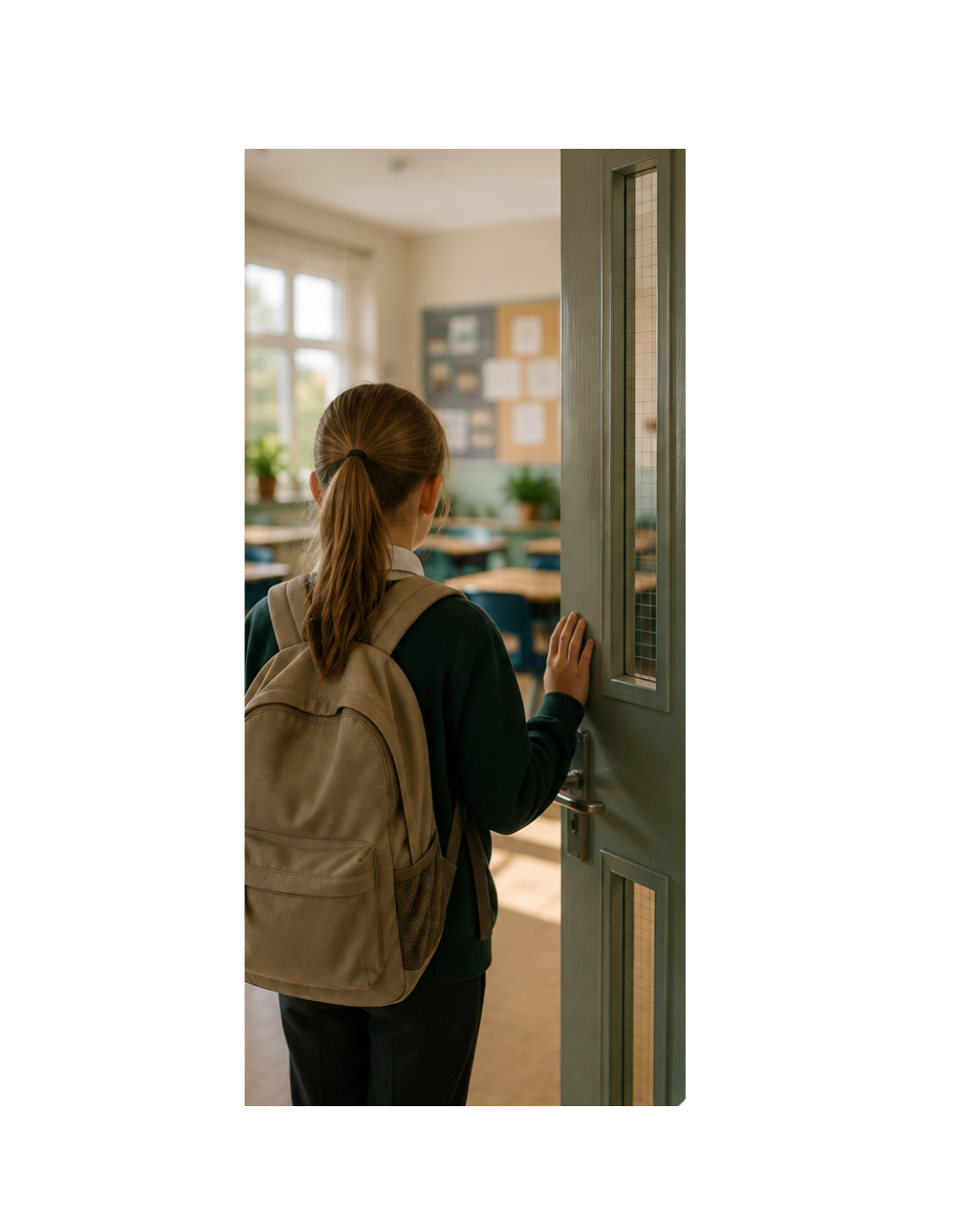
Before they Walk In
Small classroom changes that help pupils feel safe, calm and ready to learn.
Before the register. Before the lesson. Before a single word. A child has already begun to experience your classroom.
A child entering your room brings with them experiences, interactions and a learning profile that may not be immediately obvious to you. Creating a calm, accessible and inclusive classroom environment that allows some autonomy, natural movement and different ways of learning and regulating can help pupils feel more comfortable and ready to engage. It can also help create the conditions you need to do the teaching you do so well.
The ideas in this blog invite you to look at your room and consider whether one small change could soften the environment. They will not remove the need for teacher-led support or intervention. However, they may reduce some of the pressure that can show itself through verbal interruptions, difficulty engaging, repeated movement or leaving the room. For pupils with a PDA profile, having safe and appropriate opportunities for autonomy may make the classroom feel easier to manage.
This is not a one-size-fits-all checklist of tasks or things every classroom should have. Search for classroom setup ideas or a SEND-friendly classroom and you will find countless recommendations: visual timetables, movement breaks, busy displays, minimal displays, calm corners and flexible seating. The reality is that no single approach will create the right environment for every pupil, teacher, subject or space.
Teachers also bring their own needs into the room. You may have sensory sensitivities, particular triggers around behaviour and your own ways of working effectively. A classroom adjustment that supports pupils but makes it significantly harder for you to teach is unlikely to be sustainable. This blog is not designed to create more work. It is designed to help you recognise what you already do well, look at the room from your pupils’ perspectives and choose one small change to try.
Observe → Reflect → Experiment → Keep, Adapt or Scrap.
Try the change, notice what happens and ask pupils what difference, if any, it made. Keep what helps, adapt what might work differently and scrap what adds pressure without bringing value.
What is your classroom communicating?
None of this will be news to teachers. It can be incredibly frustrating when the things affecting a room are outside your control. Perhaps the seating is fixed. Maybe you teach in several different rooms and carry your resources around with you. Perhaps you have the really difficult-to-engage class, who are not remotely interested in your subject, last thing on a Friday and you dread it more than they do.
You may not be able to redesign the space, change the timetable or move the school kitchen. That doesn’t mean there is nothing you can do. Sometimes it is about looking at the room you have and thinking creatively about what might soften it.
At Family Avenues, we often talk about behaviour as communication. Here, we want to explore what the room is communicating to the pupils who enter it. Do they feel welcome? Do they feel safe? Do they feel seen and understood?
Guidance from the Education Endowment Foundation connects positive, supportive environments with stronger relationships, active engagement and a more proactive approach to behaviour. It also asks schools to consider students’ experiences in the corridors and other spaces between lessons - not only what happens once they are seated in the classroom.
One thing we hear consistently from autistic children and young people is how difficult the sensory overload of moving around school can be. Noisy corridors, physical contact, crowds, unpredictable interactions and the pressure to reach the next room on time can all add up.
If a student enters your room already feeling fizzy from the journey there, their internal safety alarms may already be sounding. When the nervous system is heightened, it can become harder to process new information, respond to demands, organise equipment or work out what is expected. This is why it matters
Imagine that you are running late for a staff meeting. You have not had time to nip to the loo. Several people have bumped into you while you were trying to get there, and you arrive feeling flustered and conspicuous. What would you need when you entered the room?
Would somebody pointing out that you are late in front of everyone help you settle? Or would a gentle, “Hi. Take your space and get yourself settled. We’re just beginning,” make it easier to join the meeting?
The expectation has not disappeared. You still need to join the meeting. But the way you are received can either increase the pressure or help you become ready to engage.
A sensory-friendly classroom does not mean the same thing for everyone
I wish I could give you a one-size-fits-all checklist for creating the perfect classroom: work through it, tick every box and magically find yourself surrounded by calm, comfortable and engaged pupils. Imagine how powerful that list would be.
The reality is more complicated. Teachers are often under pressure to create fabulous displays and fill classrooms with information that supports learning. But what if some of that useful information, or those gorgeous displays you spent hours creating, is also acting as a distraction for some of your pupils?
A 2026 experimental study involving 47 primary-aged children found that classroom displays increased off-task behaviour, with a stronger effect for the autistic pupils involved. A recent systematic review has also linked particular noises, lighting and visual distractions with poorer learning or wellbeing for some autistic students.
These findings add weight to the need to take sensory load seriously. However, they do not tell us that every colourful display is wrong, that every classroom should be stripped bare or that every autistic pupil needs the same environment.
This is where observation and student voice matter.
Gentle music might soften an uncomfortable silence for one class and add another layer of noise for another. A quieter table may be exactly what one child needs but feel exposing or isolating to somebody else. Adjustments are tools, and their usefulness depends on the pupil, the task and the room.
I would also encourage you to notice your own sensory needs. Teachers have nervous systems too. Are there sounds, movements or repeated behaviours that make it harder for you to remain calm and think clearly? What might help you manage that experience?
If it feels comfortable, you can explain what an adjustment helps you to do. This normalises support, demonstrates that different people need different things and models the self-awareness and self-advocacy we often ask of our pupils.
The aim is not to create a classroom in which nobody is ever distracted, uncomfortable or dysregulated. It is to notice what the environment is asking of everyone in it, including you, and consider whether one small change might make that demand easier to manage.
Primary and secondary classrooms are different—but the needs do not disappear
In a primary classroom, children may spend much of the day in one main room with a smaller group of familiar adults. This can make it easier to build movement, different ways of working and accessible support into the room and the class day.
It makes sense to explore that room together. Where is it easiest to listen? Where can bodies move safely? How can a child ask for help? Is the “quiet area” also expected to be the “calm area”, even though working quietly and regulating an overwhelmed nervous system may be two very different needs?
Secondary classrooms work differently. Young people move between rooms, teachers, subjects, peer groups and sets of expectations. Support cannot always be attached to one chair, one table or one familiar adult. Before your lesson, they may already have managed several different environments, social interactions, corridor transitions and demands. The first five minutes of your lesson sit at the end of that journey, not at the beginning of it.
Support does not become unnecessary in secondary school, but it may need to be offered differently: in a way that is age-respectful, acceptable to the young person and workable within the subject and classroom.
Age-respectful support is still support. Growing older changes how we offer it; it does not remove the underlying need.
Ask the students who use the room
Student voice can show us things about the room that we might otherwise miss.
It does not need to become a lengthy consultation. The Primary and Secondary Classroom Environment Reflection Tools include simple prompts to help pupils share what supports learning and what makes it harder.
Children might draw, point, choose a colour or ask an adult to record their words; older pupils may prefer to respond anonymously. Nobody needs to disclose a diagnosis or personal experience publicly for their view to count.
Tell pupils what will happen to their feedback, be honest about what cannot change and choose one pattern to explore.
Observe → Reflect → Experiment → Keep, Adapt or Scrap.
This is not about introducing an adjustment and then defending it forever. It is an experiment.
Observe: What is happening, and when?
Reflect: What might the pupil or class be experiencing?
Experiment: Try one small, realistic change, notice what happens and ask pupils what difference, if any, it made.
Keep, adapt or scrap: Use what you have learned.
An idea doesn’t have to work to be useful. If a change makes concentration harder, scrap it. If it is ignored, ask why and adapt it. If it helps, keep it and notice whether it continues to help.
Come back to the question once a term. Children change. Rooms change. Relationships change. What works in September may need adjusting by January.
Continue the reflection with Family Avenues
The Before They Walk In cards hold the reflection; this blog explores the evidence and lived experience behind it; and the free tools help you turn that thinking into one small experiment. We created separate Primary and Secondary Classroom Environment Reflection Tools because the environments—and pupils’ journeys into them—are genuinely different.
Get the free Primary Classroom Environment Reflection Tool — exploring learning, movement, asking for help and regulation.
Get the free Secondary Classroom Environment Reflection Tool — following the journey between lessons and into the first five minutes in the room.
Choose one idea from the resource—or create an experiment of your own—then observe, reflect and decide whether to keep, adapt or scrap it.
Talk to Family Avenues about professional consultation
If you would like to explore a particular classroom, transition, trigger point, learning need or distressed behaviour, Family Avenues offers professional consultations for schools. We bring professional knowledge and lived experience together to help you understand what may be happening and identify realistic next steps.
Evidence and further reading
Education Endowment Foundation (2020), Special Educational Needs in Mainstream Schools: https://educationendowmentfoundation.org.uk/education-evidence/guidance-reports/send
Education Endowment Foundation (2024), Build a culture of community and belonging for pupils: https://educationendowmentfoundation.org.uk/education-evidence/leadership-and-planning/supporting-attendance/build-a-culture-of-community-and-belonging-for-pupils
Department for Education (2021), Supporting SEND: https://www.gov.uk/government/publications/supporting-send/supporting-send
Department for Education and Department of Health and Social Care, SEND Code of Practice: 0 to 25 years: https://www.gov.uk/government/publications/send-code-of-practice-0-to-25
Jones, E. et al. (2026), The Effect of the Classroom Sensory Environment on Engagement for Autistic Pupils: https://doi.org/10.1177/27546330261443570
Melguizo-Ibáñez, E. et al. (2026), Classroom Active Breaks as a Physical-Educational Intervention for Executive Functions and Mathematical Outcomes: https://doi.org/10.1007/s10648-026-10146-3

When schools get it right
Among the stories of school battles and unmet needs, I wanted to share something different – the moments across their different schools (infant, Junior and Secondary) got it right for my autistic child. These aren’t grand expensive interventions, just thoughtful consistent actions.
Pre-diagnosis and recognising their social struggles, giving them a clipboard at breaktime with a quiz on it to give them a focus.
Giving them a “job” to help listen to the younger children read before school. They felt important and needed and it helped boost their confidence.
The teacher taking time to check in that they understood a task after setting it to the class, not assuming they did as they stayed quiet.
The young maths teacher who hands out blu-tac to children at the start of each lesson so that they have something to fidget with.
The member of staff who when they were being bullied casually asked them at lunch “do you want to stay with me this lunchtime?”
The same member of staff (who taught them in a previous year) who makes a point of patiently stopping and chatting to them each day, bantering with them and making them laugh each day.
Their art teacher who knowing they were going through a tough time asked if they wanted to go to the art room at lunchtime where the older GCSE students (two of whom were their friends) were allowed to be at lunch.
Movement breaks.
Uniform infractions are ignored! That their blazer is not always on is ignored.
That trampolining in PE is their idea of hell is understood. They aren’t made to do it.
In Spanish, they won’t speak out loud in that language in front of the class. That’s understood and any oral tests are done in private.
Teachers don’t “cold call” them and put them on the spot in a lesson.
In Science, the lovely teacher writes notes back and forth to them if they are upset. They feel safe writing it down rather than it being overheard by other students.
Rather than being made to go outside at breaktimes, they and their friend are allowed to walk the school corridors allowing them quiet and space to regulate.
They are never told off for being late to school or class.
Every member of staff in the school knows their name (in a good way I hope!) and they all say “good morning”, “lovely to see you”, fist pump them and made them feel valued and welcomed in the school.
No school is perfect, and no child’s journey is without bumps along the way. But, along the way there are moments where staff really saw them. Not just the struggles but their spark. Those moments make them feel safe, understood and genuinely cared for. And they are worth shining a light on. Its also these little acts of understanding and kindness that balance out the more difficult aspects of being at school and help build their resilience. To get all Socialworky, the protective factors for them at school. And for this I am endlessly grateful.

Asking for reasonable adjustments.
What reasonable adjustments can you request? Free template included
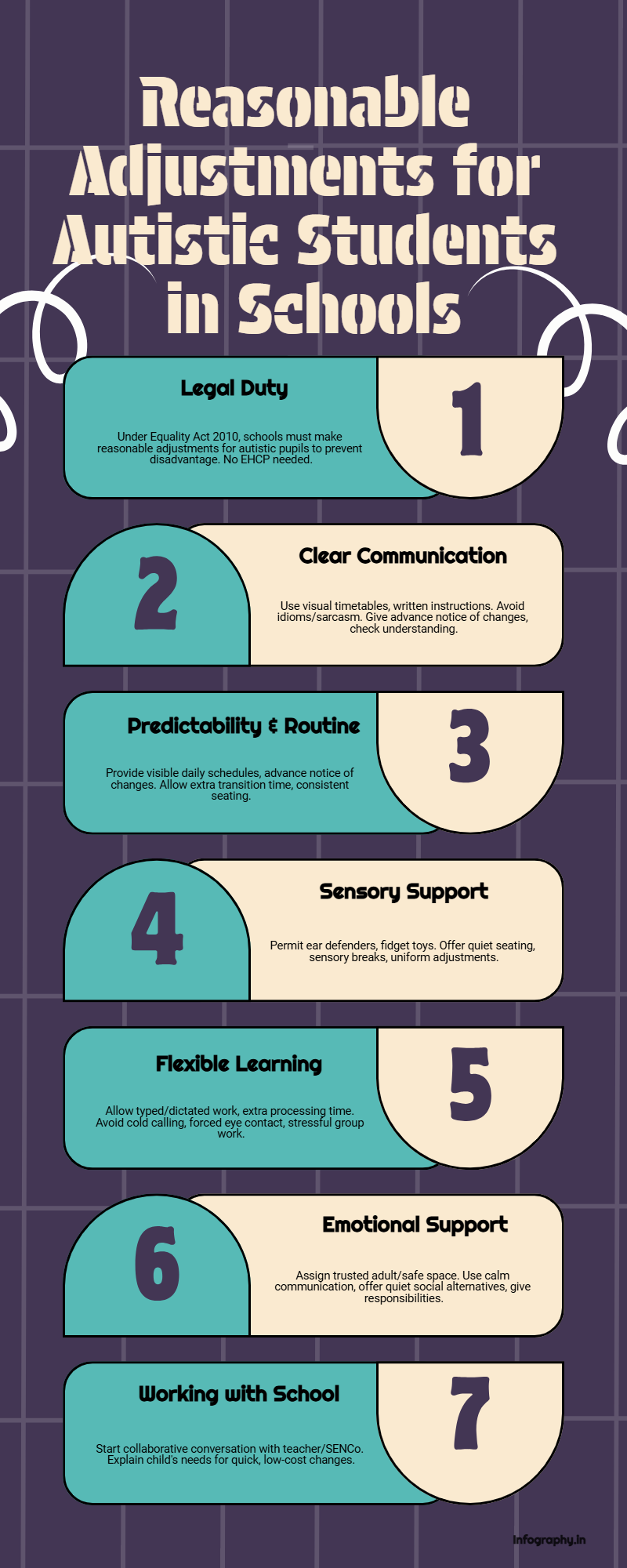
Reasonable Adjustments in Schools for Autistic Students
Simple, low-cost changes that can make school life easier
Every child deserves to feel safe, supported, and understood at school — and for autistic students, that often means making a few simple changes to help them thrive.
Under the Equality Act 2010, schools have a legal duty to make reasonable adjustments for disabled pupils, including those who are autistic. These adjustments ensure that your child isn’t placed at a disadvantage compared to others — and many of them cost little (or nothing) to put in place.
This isn’t about asking for special treatment. It’s about helping your child access learning in a way that works for them.
What Are Reasonable Adjustments?
“Reasonable adjustments” are practical steps a school can take to reduce barriers that make learning harder for your child. What’s considered reasonable depends on:
your child’s individual needs,
the school’s size and resources,
and how easily the adjustment can be made.
Most importantly, these adjustments are meant to help your child feel calm, capable, and included — not singled out.
Examples of No-Cost or Low-Cost Adjustments
Clear Communication
Use of visual timetables or written instructions.
Avoiding idioms or sarcasm; keeping communication clear and direct.
Providing reminders or prompts for key parts of the day.
Letting them know in advance of upcoming changes
Checking their understanding after a task is set
Predictability & Routine
Giving advance notice of timetable changes or special events.
Having a visible daily schedule.
Allowing extra time for transitions between activities.
Keeping seating arrangements the same
Sensory Support
Allowing ear defenders or fidget toys.
Seating your child somewhere with minimal noise or visual distractions.
Offering short sensory or movement breaks or access to a calm, quiet space.
Allow adjustments to uniform
Flexible Learning Approaches
Allowing work to be typed or dictated instead of handwritten.
Giving extra processing time to answer questions.
Not “cold calling” them in lessons (i.e asking them a question in front of the class)
Avoiding forced eye contact or group work if it causes stress.
Emotional & Social Support
Assigning a trusted adult or safe space your child can go to when overwhelmed.
Using calm, consistent communication.
Offering social alternatives — like quiet lunch clubs or supervised down-time.
Give them a job/responsibility to do on arrival at school – lay out pens, taking registers to classes.
Working with Your Child’s School
You don’t need to have an Education, Health and Care Plan (EHCP) to ask for reasonable adjustments. If your child is struggling with anxiety, meltdowns, or sensory overwhelm, these supports can often be put in place quickly by the class teacher or SENCo.
The best approach is to start a collaborative, respectful conversation with the school — explain what helps your child and what specific changes would make a difference.
Template Email for Parents
Here’s a gentle but assertive email you can adapt when reaching out to your child’s school:
Subject: Request for Reasonable Adjustments for [Child’s Name]
Dear [Teacher’s Name / SENCo],
I hope you’re well. I’m writing to discuss some reasonable adjustments that could help support [Child’s Name] in school. As you know, [he/she/they] is autistic and sometimes finds certain aspects of the school day challenging.
Many of these adjustments are small, practical changes that can make a big difference.
Here are a few ideas that could help [Child’s Name]:
[List 3–5 relevant adjustments, e.g. use of visual timetable, quiet space at breaktime, notice of timetable changes, access to fidget toy, etc.]
I’d really appreciate the opportunity to meet and discuss what’s possible so we can work together to help [Child’s Name] feel comfortable and confident at school.
Thank you so much for your time and understanding. Please let me know when would be a good time to meet or speak.
Kind regards,
[Your Name]
[Your Contact Information]
Final Thoughts
Advocating for your child doesn’t have to be a battle — it’s about working in partnership with the school so your child feels understood, supported, and happy to learn.
Remember: small adjustments can make a huge difference. And as a parent, you’re the expert on what your child needs — your voice matters.