


I get it, she’s a lot, but……
What happens when a child learns that being themselves gets them into trouble? This blog explores the hidden cost of masking and why understanding neurodivergent children matters so much.
Often, when I find myself advocating for my daughter after someone has mishandled a situation, I find myself pre-facing it with ‘I get it…’
And I do get it. My daughter has ADHD. She can’t take medication for it because it exacerbates her OCD. She is also Autistic and doesn’t pick up on social cues when she is being ‘too loud,’ ‘too impulsive,’ ‘too hyper,’ ‘disruptive,’ ‘unfiltered.’ The list goes on.
But when people mistake all of this for being ‘overconfident’ they think she can handle it when they get frustrated with her. And she absolutely cannot.
Masking is something ADHD girls in particular are expert at. When my daughter was being assessed her teacher wrote on the school forms that she ‘has no trouble sitting still and in the classroom you wouldn’t know she was there as she is so quiet.’ I cried when I read that because that does not describe my daughter at all. I knew the amount of effort going into sitting still and not drawing attention to herself had already come at a significant expense and as a result she was now in burnout and we were scrambling to learn how to help her recover.
Since then, my daughter’s primary school had a better understanding of her needs. She stopped going to the clubs she had previously enjoyed because she was so worried about being told off if she got excited. We joined a group for Autistic girls where she could be herself. A huge amount of effort and resources has gone into accessing the right mental health support for her and an educational environment that can meet her needs when she starts secondary school in September.
A couple of months ago, for the first time in three years, I found myself saying ‘It’s like she’s her old self again.’
Because she was so relaxed, regulated, and genuinely cheerful. She was playing out with children on our street on their scooters, happily skipping off to school in the mornings, singing loudly without even realising and we were not seeing the distressing evidence of anxiety that had become part of daily life. Nothing makes me happier than seeing my child thriving. That is all any parent wants. And my daughter’s personality is what makes her sparkle and we love her so much for it.
However, we then saw the cycle again where people (peers and adults) would get frustrated with her and she would get into trouble. For being happy. Not because she was doing anything wrong. Not because she was ever remotely unkind.
And no matter how much I preface my advocacy with ‘I get it but…’ the reality is what I was about to say constitutes to ‘you caused her significant distress for something she literally cannot control.’ And that absolutely breaks my heart.
Because, every time something happens where she has been excited, happy, impulsive, noisy, and she has been told she is ‘disrespectful’ or ‘hurting my ears’ or ‘not listening,’ what she takes from that is that she let the mask slip and she must fix it back on in order to protect herself.
That might make those people feel more content around her. But that mask is unsustainable for her nervous system.
So; whether you are the relative, friend, teacher or any other professional… If you are lucky enough to have a sparkly ADHD child in your life – please look beyond their presentation and don’t mistake ‘confidence’ for being able to receive negative feedback from you.
Redirect them, or gently explain something to them without embarrassing them.
But please, please, don’t dim their sparkle.
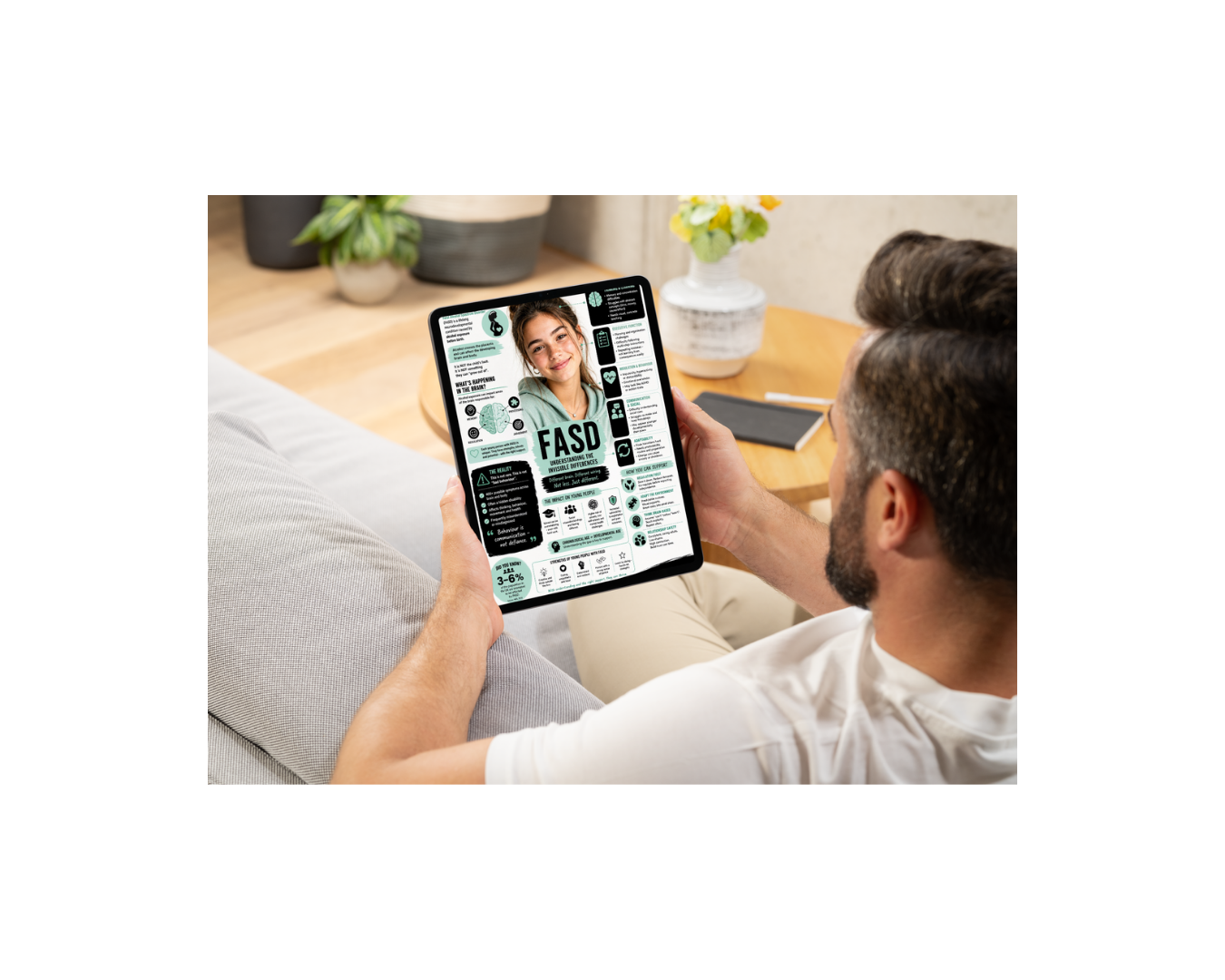
FASD: Understanding the Invisible Differences
There are children and young people walking into schools every day who are trying their absolute best… and still being misunderstood. Not because they won’t, but because their brains work differently.
One of the most overlooked reasons for this?
Foetal Alcohol Spectrum Disorder (FASD).
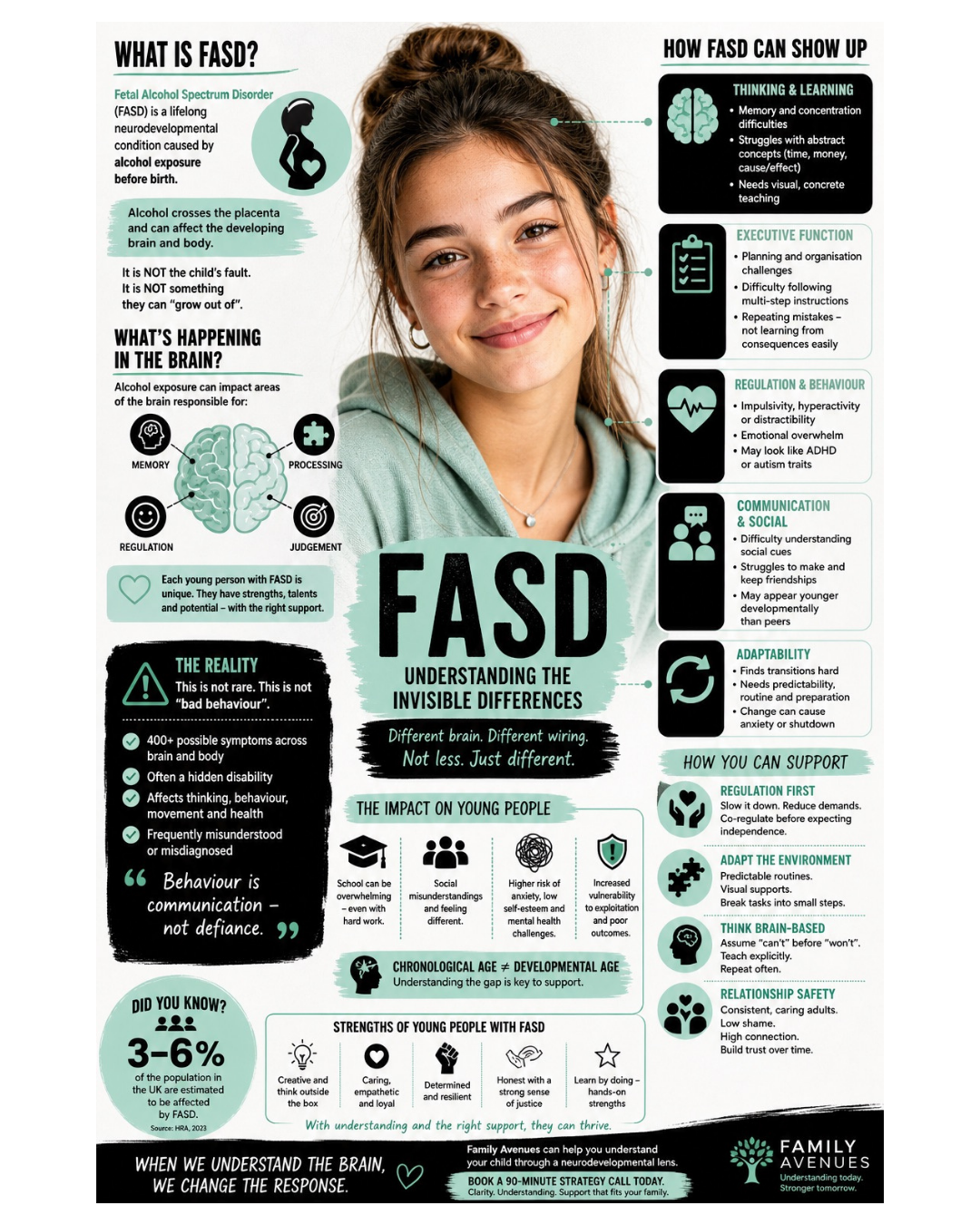
What is FASD?
FASD is a lifelong neurodevelopmental condition caused by alcohol exposure during pregnancy.
Alcohol crosses the placenta and can affect the developing brain and body at any stage of pregnancy — often before someone even knows they are pregnant.
FASD isn’t always visible. You won’t necessarily “see” it in the way people expect. But it can impact:
Memory and processing
Emotional regulation
Impulse control
Understanding consequences
Social communication
Which means what often gets labelled as:
“defiance”
“attention seeking”
“lazy”
“not trying”
…is very often something else entirely.
It’s brain-based. Not behaviour-based.
What Causes FASD?
FASD is caused by prenatal exposure to alcohol.
And this is where we need to be really clear — because this is where the myths do damage.
It is not just caused by:
heavy drinking
alcohol dependency
repeated high consumption
FASD can occur when:
alcohol is consumed before pregnancy is known
drinking happens occasionally or socially
exposure happens at critical points in brain development
There is no known safe amount of alcohol in pregnancy. And crucially:
It is not always about “heavy drinking”
It can happen in pregnancies where there was no intention to cause harm
It is often linked to lack of awareness, mixed messaging, or timing
Let’s Gently Dispel a Harmful Myth
There’s a narrative that FASD only happens in “extreme” situations.
That it’s rare.
That it’s obvious.
That it’s someone else’s story.
That narrative stops recognition.
And when we don’t recognise it — we misinterpret it.
Some people believe:
“Surely one drink won’t matter.”
The truth is more uncomfortable. We cannot predict how alcohol will affect a developing brain. We don’t know what amount may cause harm in any individual pregnancy. Which is why the guidance is clear:
No alcohol = no risk.
But this isn’t about blame. Because many parents:
didn’t know they were pregnant
weren’t planning/trying to conceive
were given conflicting advice
were told small amounts were “fine”
So instead of blame, we need understanding.
How Common is FASD?
FASD is more common than most people realise.
In the UK, estimates suggest:
Around 3–6% of the population may be affected
That’s potentially 1 in every classroom
Yet it remains:
underdiagnosed
misunderstood
often mislabelled as ADHD, autism, trauma, or “challenging behaviour”
Sometimes it sits alongside those — sometimes it’s missed entirely.
The Impact on Children and Young People
For a child with FASD, the world can feel confusing and unpredictable.
You might see:
big emotional reactions that seem to come “out of nowhere”
difficulty following multi-step instructions
repeating the same mistakes despite consequences
struggles with friendships
anxiety or shutdown when things change
And over time? Without understanding, that can turn into:
low self-esteem
school avoidance
exclusion
mental health difficulties
Not because they can’t thrive, but because the environment hasn’t adapted to them.
Can FASD Be Prevented?
Yes — in a very clear, simple way:
By avoiding alcohol during pregnancy.
But prevention isn’t just about individual choices.
It’s about:
clear, consistent public health messaging
removing mixed advice (“a little is fine”)
supporting people before and during pregnancy
reducing stigma so conversations can happen openly
Because silence and shame don’t prevent FASD, information and support do.
What Actually Helps?
When we understand the brain, everything changes.
Support isn’t about stricter boundaries or harsher consequences.
It’s about:
co-regulation before expectation
simplifying and breaking down instructions
repetition without shame
predictability and routine
reducing overwhelm in the environment
And most importantly seeing the child, not just the behaviour.
A Final Thought
Children with FASD are often described as:
kind
funny
determined
full of potential
But they are also often the children who get misunderstood the most because their differences are invisible. So when we shift from “What’s wrong with them?” to “What’s going on in their brain?”, we don’t just change how we respond, we change their entire experience of the world.
Need Support?
If you’re a parent or professional trying to make sense of behaviour that doesn’t quite “fit” — you’re not alone.
At Family Avenues, we help you understand what’s underneath the behaviour and what actually helps.
Our 90-minute Direction Call gives you clarity, practical strategies, and a way forward that fits your family.
Organisations offering FASD support:

All things Stimming

More than what it looks like
When people hear the word stimming, they often picture hand flapping or rocking.
And yes — those are forms of stimming.
But that’s only part of the picture.
Stimming (short for self-stimulatory behaviour) is something many autistic people — and neurodivergent people more broadly — use to regulate their emotions, process sensory input, and feel more in control of their environment.
It isn’t just something children do. It isn’t always obvious. And it isn’t something that needs to be “stopped”.
What is stimming?
Stimming refers to repetitive movements, sounds, or behaviours that help a person regulate.
This might be:
• calming themselves when overwhelmed • focusing or concentrating • expressing excitement • managing anxiety • or simply doing something that feels good
For many, it’s a natural and essential way of coping.
It doesn’t always look how you expect
Some stimming is easy to recognise.
But much of it is subtle — especially in older children and adults.
More obvious stimming
• Hand flapping • Rocking • Spinning • Repeating sounds or phrases • Jumping or pacing
Less obvious stimming (often missed or misunderstood)
• Twirling or playing with hair • Picking at skin, nails, or clothing • Chewing on pens, sleeves, or inside of cheeks • Tapping fingers or feet in patterns • Clicking pens or opening/closing objects repeatedly • Rubbing fabrics, labels, or textures • Re-reading the same sentence or paragraph • Doodling repetitive patterns • Listening to the same song or sound on repeat • Shifting posture frequently
These behaviours are often seen as habits, fidgeting, or even “distracting behaviour” — but they are often doing an important regulatory job.
Stimming in adults
Many adults still stim — but it may look different.
Over time, people often learn to mask or adapt their stimming so it appears more socially acceptable.
This might look like:
• tapping a foot under the table • fiddling with jewellery • using a phone or scrolling repeatedly • drinking or smoking more frequently • needing constant background noise
Sometimes, adults don’t even realise they are stimming — they just know certain things help them feel calmer or more focused.
Why stimming matters
Stimming is not “bad behaviour”.
It is:
👉 communication 👉 regulation 👉 a coping strategy
When we try to stop stimming without understanding it, we risk removing something that is helping the person manage their environment.
Do we ever need to worry?
In most cases, no.
Stimming is a healthy and important part of regulation.
However, it may need more attention if:
• it is causing physical harm (e.g. skin damage, hair pulling) • it is causing significant pain • it is putting the person or others at risk
Even then, the goal isn’t to stop the stimming entirely — it’s to understand the need behind it and support safer alternatives.
What actually helps
The most helpful starting point is curiosity.
Rather than asking:
👉 “How do I stop this?”
Try asking:
👉 “What might this person need right now?”
Helpful approaches
✔ Allow safe stimming If it isn’t causing harm, it’s often best to let it be.
✔ Look for patterns When does it happen? What’s going on just before?
✔ Reduce overwhelm Stimming often increases when environments feel too much.
✔ Offer alternatives (if needed) Fidget tools, chewable items, or sensory objects can help where behaviours are causing discomfort.
✔ Support regulation proactively Movement breaks, quiet time, or sensory input before things escalate.
✔ Respond with curiosity, not correction This shift alone can change everything.
A final thought
Not all stimming is visible. Not all stimming is understood.
But for many people, it is an essential part of how they move through the world.
When we begin to see stimming not as something to stop, but as something to understand, we move closer to supporting people in a way that truly meets their needs.
At Family Avenues
We support families and professionals to better understand behaviour, reduce overwhelm, and find strategies that work in real life.
👉 Explore our free resource hub or services to find out more.