

When schools get it right
Among the stories of school battles and unmet needs, I wanted to share something different – the moments across their different schools (infant, Junior and Secondary) got it right for my autistic child. These aren’t grand expensive interventions, just thoughtful consistent actions.
Pre-diagnosis and recognising their social struggles, giving them a clipboard at breaktime with a quiz on it to give them a focus.
Giving them a “job” to help listen to the younger children read before school. They felt important and needed and it helped boost their confidence.
The teacher taking time to check in that they understood a task after setting it to the class, not assuming they did as they stayed quiet.
The young maths teacher who hands out blu-tac to children at the start of each lesson so that they have something to fidget with.
The member of staff who when they were being bullied casually asked them at lunch “do you want to stay with me this lunchtime?”
The same member of staff (who taught them in a previous year) who makes a point of patiently stopping and chatting to them each day, bantering with them and making them laugh each day.
Their art teacher who knowing they were going through a tough time asked if they wanted to go to the art room at lunchtime where the older GCSE students (two of whom were their friends) were allowed to be at lunch.
Movement breaks.
Uniform infractions are ignored! That their blazer is not always on is ignored.
That trampolining in PE is their idea of hell is understood. They aren’t made to do it.
In Spanish, they won’t speak out loud in that language in front of the class. That’s understood and any oral tests are done in private.
Teachers don’t “cold call” them and put them on the spot in a lesson.
In Science, the lovely teacher writes notes back and forth to them if they are upset. They feel safe writing it down rather than it being overheard by other students.
Rather than being made to go outside at breaktimes, they and their friend are allowed to walk the school corridors allowing them quiet and space to regulate.
They are never told off for being late to school or class.
Every member of staff in the school knows their name (in a good way I hope!) and they all say “good morning”, “lovely to see you”, fist pump them and made them feel valued and welcomed in the school.
No school is perfect, and no child’s journey is without bumps along the way. But, along the way there are moments where staff really saw them. Not just the struggles but their spark. Those moments make them feel safe, understood and genuinely cared for. And they are worth shining a light on. Its also these little acts of understanding and kindness that balance out the more difficult aspects of being at school and help build their resilience. To get all Socialworky, the protective factors for them at school. And for this I am endlessly grateful.

Asking for reasonable adjustments.
What reasonable adjustments can you request? Free template included
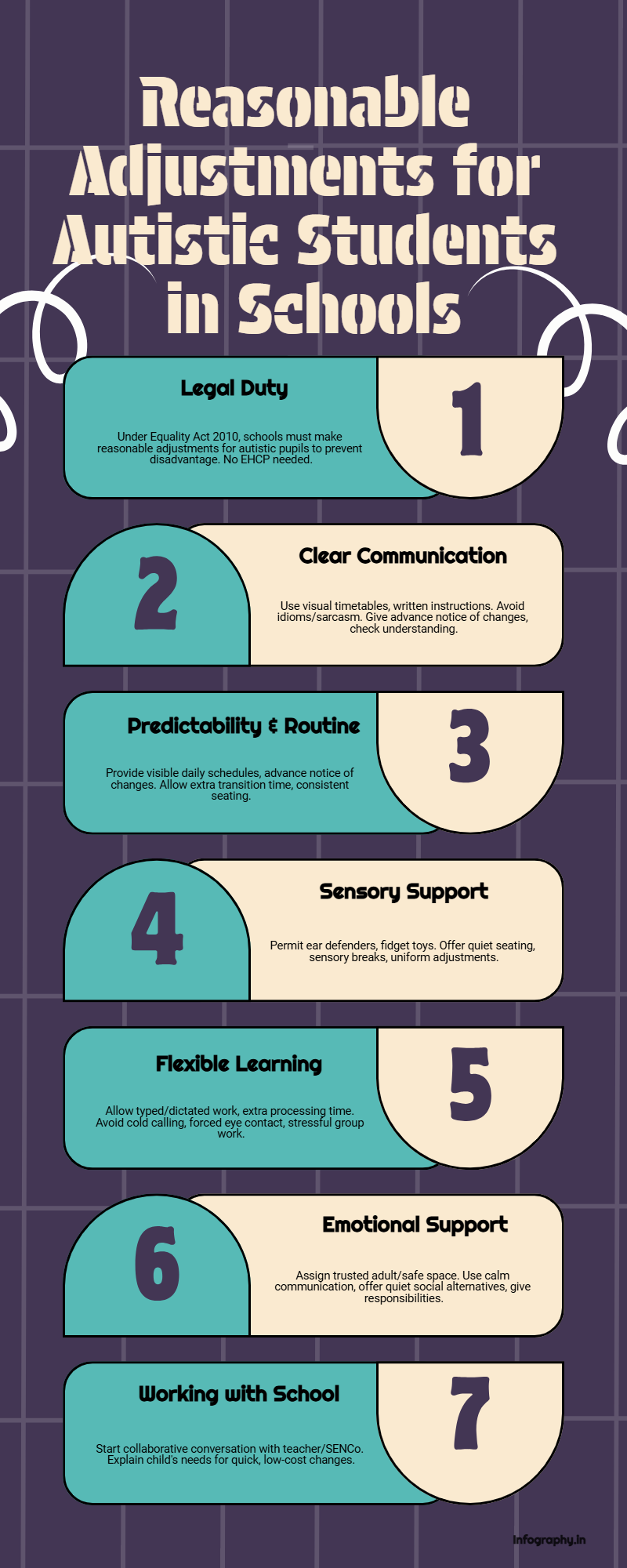
Reasonable Adjustments in Schools for Autistic Students
Simple, low-cost changes that can make school life easier
Every child deserves to feel safe, supported, and understood at school — and for autistic students, that often means making a few simple changes to help them thrive.
Under the Equality Act 2010, schools have a legal duty to make reasonable adjustments for disabled pupils, including those who are autistic. These adjustments ensure that your child isn’t placed at a disadvantage compared to others — and many of them cost little (or nothing) to put in place.
This isn’t about asking for special treatment. It’s about helping your child access learning in a way that works for them.
What Are Reasonable Adjustments?
“Reasonable adjustments” are practical steps a school can take to reduce barriers that make learning harder for your child. What’s considered reasonable depends on:
your child’s individual needs,
the school’s size and resources,
and how easily the adjustment can be made.
Most importantly, these adjustments are meant to help your child feel calm, capable, and included — not singled out.
Examples of No-Cost or Low-Cost Adjustments
Clear Communication
Use of visual timetables or written instructions.
Avoiding idioms or sarcasm; keeping communication clear and direct.
Providing reminders or prompts for key parts of the day.
Letting them know in advance of upcoming changes
Checking their understanding after a task is set
Predictability & Routine
Giving advance notice of timetable changes or special events.
Having a visible daily schedule.
Allowing extra time for transitions between activities.
Keeping seating arrangements the same
Sensory Support
Allowing ear defenders or fidget toys.
Seating your child somewhere with minimal noise or visual distractions.
Offering short sensory or movement breaks or access to a calm, quiet space.
Allow adjustments to uniform
Flexible Learning Approaches
Allowing work to be typed or dictated instead of handwritten.
Giving extra processing time to answer questions.
Not “cold calling” them in lessons (i.e asking them a question in front of the class)
Avoiding forced eye contact or group work if it causes stress.
Emotional & Social Support
Assigning a trusted adult or safe space your child can go to when overwhelmed.
Using calm, consistent communication.
Offering social alternatives — like quiet lunch clubs or supervised down-time.
Give them a job/responsibility to do on arrival at school – lay out pens, taking registers to classes.
Working with Your Child’s School
You don’t need to have an Education, Health and Care Plan (EHCP) to ask for reasonable adjustments. If your child is struggling with anxiety, meltdowns, or sensory overwhelm, these supports can often be put in place quickly by the class teacher or SENCo.
The best approach is to start a collaborative, respectful conversation with the school — explain what helps your child and what specific changes would make a difference.
Template Email for Parents
Here’s a gentle but assertive email you can adapt when reaching out to your child’s school:
Subject: Request for Reasonable Adjustments for [Child’s Name]
Dear [Teacher’s Name / SENCo],
I hope you’re well. I’m writing to discuss some reasonable adjustments that could help support [Child’s Name] in school. As you know, [he/she/they] is autistic and sometimes finds certain aspects of the school day challenging.
Many of these adjustments are small, practical changes that can make a big difference.
Here are a few ideas that could help [Child’s Name]:
[List 3–5 relevant adjustments, e.g. use of visual timetable, quiet space at breaktime, notice of timetable changes, access to fidget toy, etc.]
I’d really appreciate the opportunity to meet and discuss what’s possible so we can work together to help [Child’s Name] feel comfortable and confident at school.
Thank you so much for your time and understanding. Please let me know when would be a good time to meet or speak.
Kind regards,
[Your Name]
[Your Contact Information]
Final Thoughts
Advocating for your child doesn’t have to be a battle — it’s about working in partnership with the school so your child feels understood, supported, and happy to learn.
Remember: small adjustments can make a huge difference. And as a parent, you’re the expert on what your child needs — your voice matters.