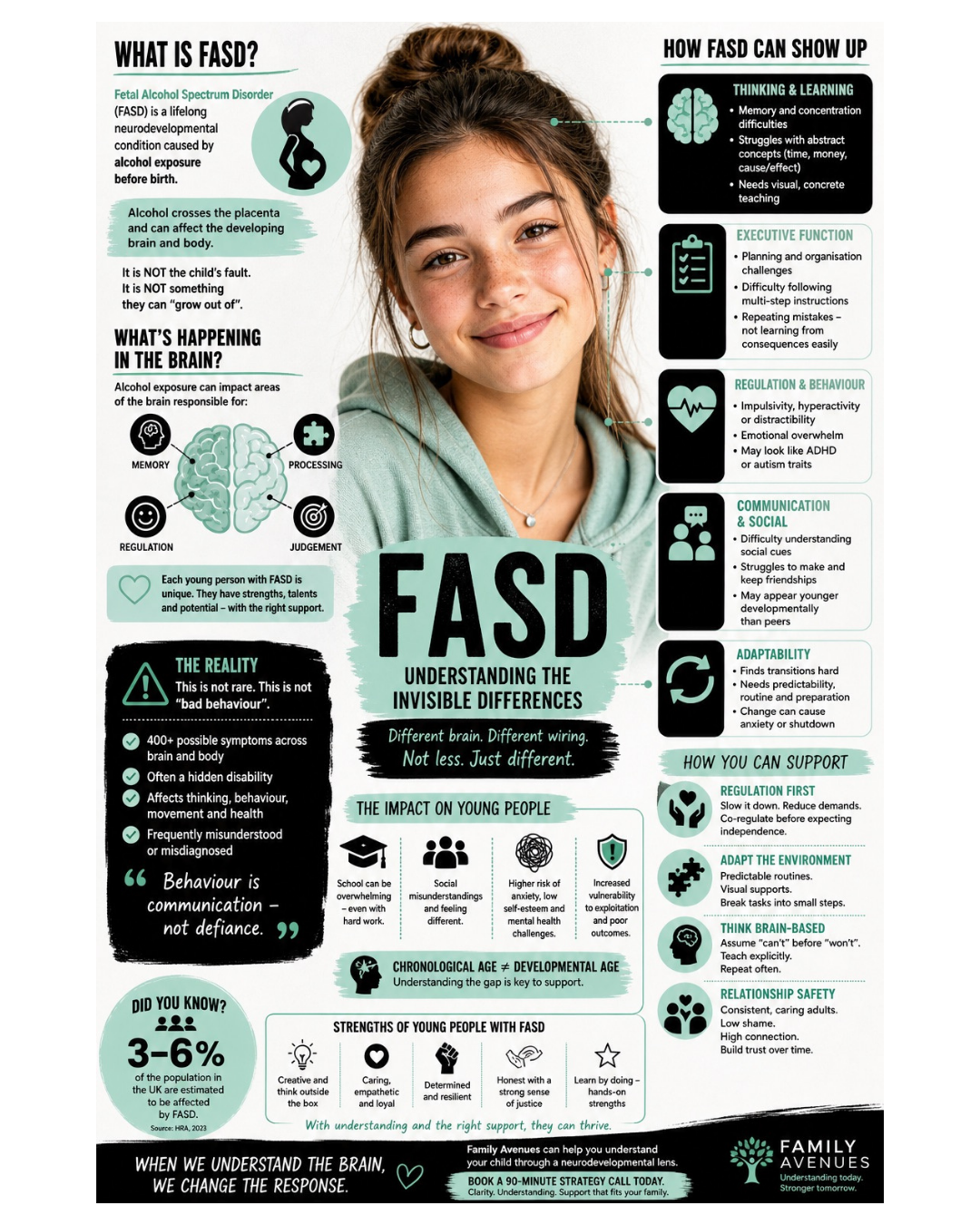

FASD: Understanding the Invisible Differences
There are children and young people walking into schools every day who are trying their absolute best… and still being misunderstood. Not because they won’t, but because their brains work differently.
One of the most overlooked reasons for this?
Foetal Alcohol Spectrum Disorder (FASD).
What is FASD?
FASD is a lifelong neurodevelopmental condition caused by alcohol exposure during pregnancy.
Alcohol crosses the placenta and can affect the developing brain and body at any stage of pregnancy — often before someone even knows they are pregnant.
FASD isn’t always visible. You won’t necessarily “see” it in the way people expect. But it can impact:
Memory and processing
Emotional regulation
Impulse control
Understanding consequences
Social communication
Which means what often gets labelled as:
“defiance”
“attention seeking”
“lazy”
“not trying”
…is very often something else entirely.
It’s brain-based. Not behaviour-based.
What Causes FASD?
FASD is caused by prenatal exposure to alcohol.
And this is where we need to be really clear — because this is where the myths do damage.
It is not just caused by:
heavy drinking
alcohol dependency
repeated high consumption
FASD can occur when:
alcohol is consumed before pregnancy is known
drinking happens occasionally or socially
exposure happens at critical points in brain development
There is no known safe amount of alcohol in pregnancy. And crucially:
It is not always about “heavy drinking”
It can happen in pregnancies where there was no intention to cause harm
It is often linked to lack of awareness, mixed messaging, or timing
Let’s Gently Dispel a Harmful Myth
There’s a narrative that FASD only happens in “extreme” situations.
That it’s rare.
That it’s obvious.
That it’s someone else’s story.
That narrative stops recognition.
And when we don’t recognise it — we misinterpret it.
Some people believe:
“Surely one drink won’t matter.”
The truth is more uncomfortable. We cannot predict how alcohol will affect a developing brain. We don’t know what amount may cause harm in any individual pregnancy. Which is why the guidance is clear:
No alcohol = no risk.
But this isn’t about blame. Because many parents:
didn’t know they were pregnant
weren’t planning/trying to conceive
were given conflicting advice
were told small amounts were “fine”
So instead of blame, we need understanding.
How Common is FASD?
FASD is more common than most people realise.
In the UK, estimates suggest:
Around 3–6% of the population may be affected
That’s potentially 1 in every classroom
Yet it remains:
underdiagnosed
misunderstood
often mislabelled as ADHD, autism, trauma, or “challenging behaviour”
Sometimes it sits alongside those — sometimes it’s missed entirely.
The Impact on Children and Young People
For a child with FASD, the world can feel confusing and unpredictable.
You might see:
big emotional reactions that seem to come “out of nowhere”
difficulty following multi-step instructions
repeating the same mistakes despite consequences
struggles with friendships
anxiety or shutdown when things change
And over time? Without understanding, that can turn into:
low self-esteem
school avoidance
exclusion
mental health difficulties
Not because they can’t thrive, but because the environment hasn’t adapted to them.
Can FASD Be Prevented?
Yes — in a very clear, simple way:
By avoiding alcohol during pregnancy.
But prevention isn’t just about individual choices.
It’s about:
clear, consistent public health messaging
removing mixed advice (“a little is fine”)
supporting people before and during pregnancy
reducing stigma so conversations can happen openly
Because silence and shame don’t prevent FASD, information and support do.
What Actually Helps?
When we understand the brain, everything changes.
Support isn’t about stricter boundaries or harsher consequences.
It’s about:
co-regulation before expectation
simplifying and breaking down instructions
repetition without shame
predictability and routine
reducing overwhelm in the environment
And most importantly seeing the child, not just the behaviour.
A Final Thought
Children with FASD are often described as:
kind
funny
determined
full of potential
But they are also often the children who get misunderstood the most because their differences are invisible. So when we shift from “What’s wrong with them?” to “What’s going on in their brain?”, we don’t just change how we respond, we change their entire experience of the world.
Need Support?
If you’re a parent or professional trying to make sense of behaviour that doesn’t quite “fit” — you’re not alone.
At Family Avenues, we help you understand what’s underneath the behaviour and what actually helps.
Our 90-minute Direction Call gives you clarity, practical strategies, and a way forward that fits your family.
Organisations offering FASD support: